Turkmenistan Payroll & Employment Guide
This guide is intended for companies that engage employees through a local company or branch in Turkmenistan and for companies managing cross-border payroll. It explains the general private-sector rules accessible as of 26 October 2026. A licensed sector, state contract, free economic zone, hazardous role, foreign-worker status or collective agreement may produce a different result.
- 12
- pages
- 9
- chapters
- 626
- words
- TMT
- currency
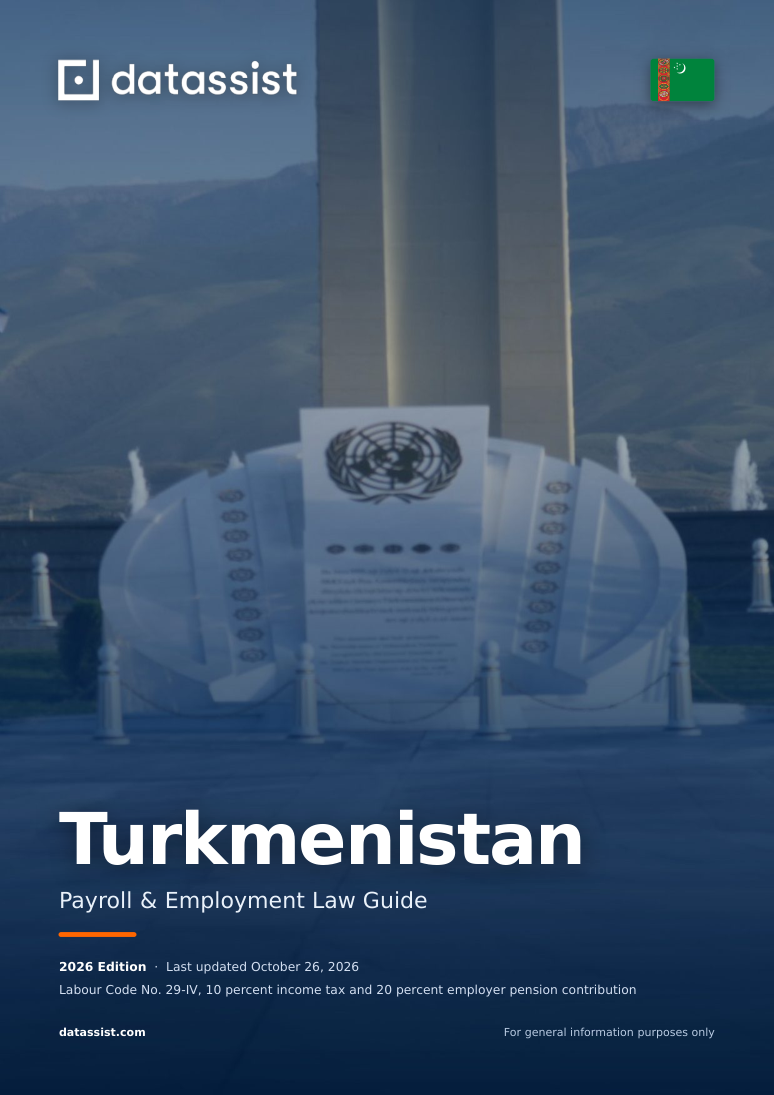
At a glance
At a Glance
- TMT 1,410
- 2026 monthly minimum wage
- 40h
- Maximum normal working week
- 30 days
- Basic annual leave
- 20%
- Standard employer pension contribution
What's in the guide
9 chapters, 12 pages
The opening summary of each chapter is below. Full text, tables and rates are in the PDF.
Company Formation and Business Environment
Employer structure, registrations and the contract layer.
Entity choice, registration approvals and the identity of the payroll employer must be planned together in Turkmenistan. A foreign investor may establish a wholly foreign-owned enterprise, invest in a local enterprise or open a branch. A holding of at least 10 percent of the capital is required for the definition of foreign direct investment.
Working Conditions and Leave Entitlements
Working time, leave and periodic payment rules.
The Labor Code dated 18 April 2009, No. 29-IV, limits normal working time to 40 hours a week. A five-day or six-day week may apply. Shorter limits protect hazardous roles and younger workers.
Tax and Social Security
Income tax, contributions and social security parameters.
The general personal income tax rate on employment income is 10 percent. The employer also pays a compulsory 20 percent contribution to the Turkmenistan Pension Fund on standard payroll. The compulsory employee pension contribution for a standard employee is 0 percent.
Payroll Operations
Payroll calendar, filings and record obligations.
Payroll should establish an auditable chain across the employer order, work record, time record, salary calculation, PIT and Pension Fund declaration. Salary is paid at least every half month, meaning at least 2 times a month.
Hiring and Termination
Onboarding, contracts, notice and termination controls.
Hiring is formalized by an employer order based on the employee's application. The order is presented for signature within 3 days. A fixed-term contract may last no more than 5 years and must be justified by the nature or conditions of the work.
Wages and Benefits
Pay floors, additional payments and benefits.
An employee who fulfills the full working norm cannot be paid less than the monthly floor of TMT 1,410. No automatic annual wage increase or compulsory 13th salary applying to every private-sector employer was verified.
Visas and Work Permits
Local hiring, foreign workers and mobility rules.
The Migration Law dated 31 March 2012, No. 290-IV, including the amendments of 11 April 2026, requires a foreign employee to obtain a work permit before starting work. The competent authority is the State Migration Service of Turkmenistan.
Practical Notes and Compliance Risks
Controls before first payroll and throughout the operation.
The main payroll risk in Turkmenistan is treating a statutory entitlement and agency practice as the same thing. Registration, foreign exchange, migration and document flows may require additional approval in practice.
Incentives and Employer Support Schemes
2026 employer support and conditional incentive schemes.
The standard employer pension contribution is 20 percent. As of 26 October 2026, no broad payroll-relief catalogue comparable to Türkiye's SGK incentive codes was verified as open to all private employers.
This guide is for general information only; it is not legal advice or a complete statement of the law. The content reflects the legislation in force when it was prepared, and legislation changes. Always take country-specific professional advice on a concrete case.
With Datassist
Running payroll and employment operations in Turkmenistan
Employing people in Turkmenistan means applying the rules in this guide every payroll period: tax and social security filings, salary payments, leave and termination calculations. Datassist teams help you manage this process from a single point in Turkey.
Other countries
Other country guides
- UZS 1,360,000
- 2026 statutory monthly minimum wage
- 40 hours
- Maximum standard working week
Company Formation · Working Conditions and Leave · Tax and Social Security · Payroll Operations
View Guide
- KGS 3,280
- 2026 monthly minimum wage
- 40h
- Standard working week
Company Formation and Business Environment · Working Conditions and Leave Entitlements · Tax and Social Security · Payroll Operations · Hiring and Termination · Wages and Benefits · Visas and Work Permits · Practical Notes and Compliance Risks · Incentives and Employer Support Schemes
View Guide
- KZT 85,000
- 2026 monthly minimum wage
- 40h
- Standard working week
Company Formation and Business Environment · Working Conditions and Leave Entitlements · Tax and Social Security · Payroll Operations · Hiring and Termination · Wages and Benefits · Visas and Work Permits · Practical Notes and Compliance Risks · Incentives and Employer Support Schemes
View Guide