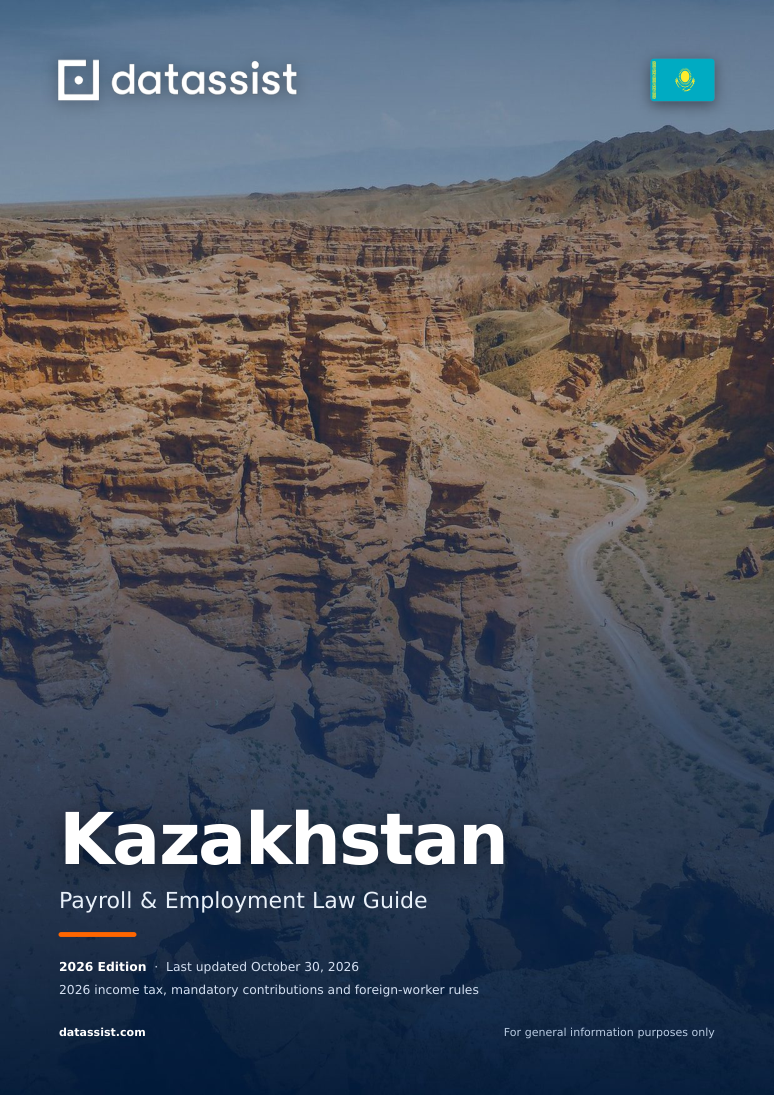
Kazakhstan Payroll & Employment Guide
This guide is for employers engaging staff through a Kazakhstan entity or managing Kazakhstan payroll within a multi-country operation as of October 30, 2026. It covers general private-sector rules. Citizenship, residence, Eurasian Economic Union status and hazardous-work class can change contribution coverage.
- 11
- pages
- 9
- chapters
- 609
- words
- KZT
- currency
At a glance
At a Glance
- KZT 85,000
- 2026 monthly minimum wage
- 40h
- Standard working week
- 10%
- Employee pension contribution
- 3%
- Employer medical contribution
What's in the guide
9 chapters, 11 pages
The opening summary of each chapter is below. Full text, tables and rates are in the PDF.
Company Formation and Business Environment
Employer structure, registrations and the contract layer.
Foreign investors commonly use a limited liability partnership, or LLP. Standard legal entities classified as private businesses can register electronically through eGov. Registration allocates a BIN, which anchors the employer's tax, banking and insurance processes.
Working Conditions and Leave Entitlements
Working time, leave and periodic payment rules.
Normal working time may not exceed 40 hours a week. Overtime must be paid at no less than 1.5 times the rate, and weekend or public-holiday work at no less than 1.5 times. Night work is also paid at no less than 1.5 times.
Tax and Social Security
Income tax, contributions and social security parameters.
In 2026, employment income is taxed at 10% up to annual income of 8,500 MCI and 15% on the excess. The 2026 MCI is KZT 4,325, making the annual threshold KZT 36,762,500.
Payroll Operations
Payroll calendar, filings and record obligations.
Salary is paid in KZT at least monthly. The employer withholds income tax and employee contributions, calculates employer contributions and reconciles payments to employee-level records.
Hiring and Termination
Onboarding, contracts, notice and termination controls.
The employment contract must be in writing and cover the role, workplace, duration, pay and working conditions. Probation is generally capped at 3 months. A longer period may apply to certain management roles where permitted by law or contract.
Wages and Benefits
Pay floors, additional payments and benefits.
There is no general statutory 13th salary obligation in the private sector. Bonuses, meals, transport, housing, private insurance and other benefits may arise under the contract, collective agreement or employer policy.
Visas and Work Permits
Local hiring, foreign workers and mobility rules.
Eurasian Economic Union citizens working under a local employment contract are generally outside the work-permit quota. For other foreigners, the employer needs a work permit from the local executive authority and the worker must complete immigration status.
Practical Notes and Compliance Risks
Controls before first payroll and throughout the operation.
A key Kazakhstan payroll risk is treating different contribution ceilings as one cap and separating the foreign worker's citizenship and residence status from payroll parameters. Lock the MCI and minimum wage as annual parameters.
Incentives and Employer Support Schemes
2026 employer support and conditional incentive schemes.
Career centres arrange subsidised jobs based on eligible employer applications. Under the 2026 rules, private commercial organisations, individual entrepreneurs, farms and social enterprises may generally apply for 1 to 5 subsidised positions.
This guide is for general information only; it is not legal advice or a complete statement of the law. The content reflects the legislation in force when it was prepared, and legislation changes. Always take country-specific professional advice on a concrete case.
With Datassist
Running payroll and employment operations in Kazakhstan
The tax, contribution, working-time and leave rules in this guide must be applied with current data in every payroll period. Datassist supports Kazakhstan payroll and employment obligations from one point in Türkiye.
Other countries
Other country guides
- UZS 1,360,000
- 2026 statutory monthly minimum wage
- 40 hours
- Maximum standard working week
Company Formation · Working Conditions and Leave · Tax and Social Security · Payroll Operations
View Guide
- KGS 3,280
- 2026 monthly minimum wage
- 40h
- Standard working week
Company Formation and Business Environment · Working Conditions and Leave Entitlements · Tax and Social Security · Payroll Operations · Hiring and Termination · Wages and Benefits · Visas and Work Permits · Practical Notes and Compliance Risks · Incentives and Employer Support Schemes
View Guide
- TMT 1,410
- 2026 monthly minimum wage
- 40h
- Maximum normal working week
Company Formation and Business Environment · Working Conditions and Leave Entitlements · Tax and Social Security · Payroll Operations · Hiring and Termination · Wages and Benefits · Visas and Work Permits · Practical Notes and Compliance Risks · Incentives and Employer Support Schemes
View Guide