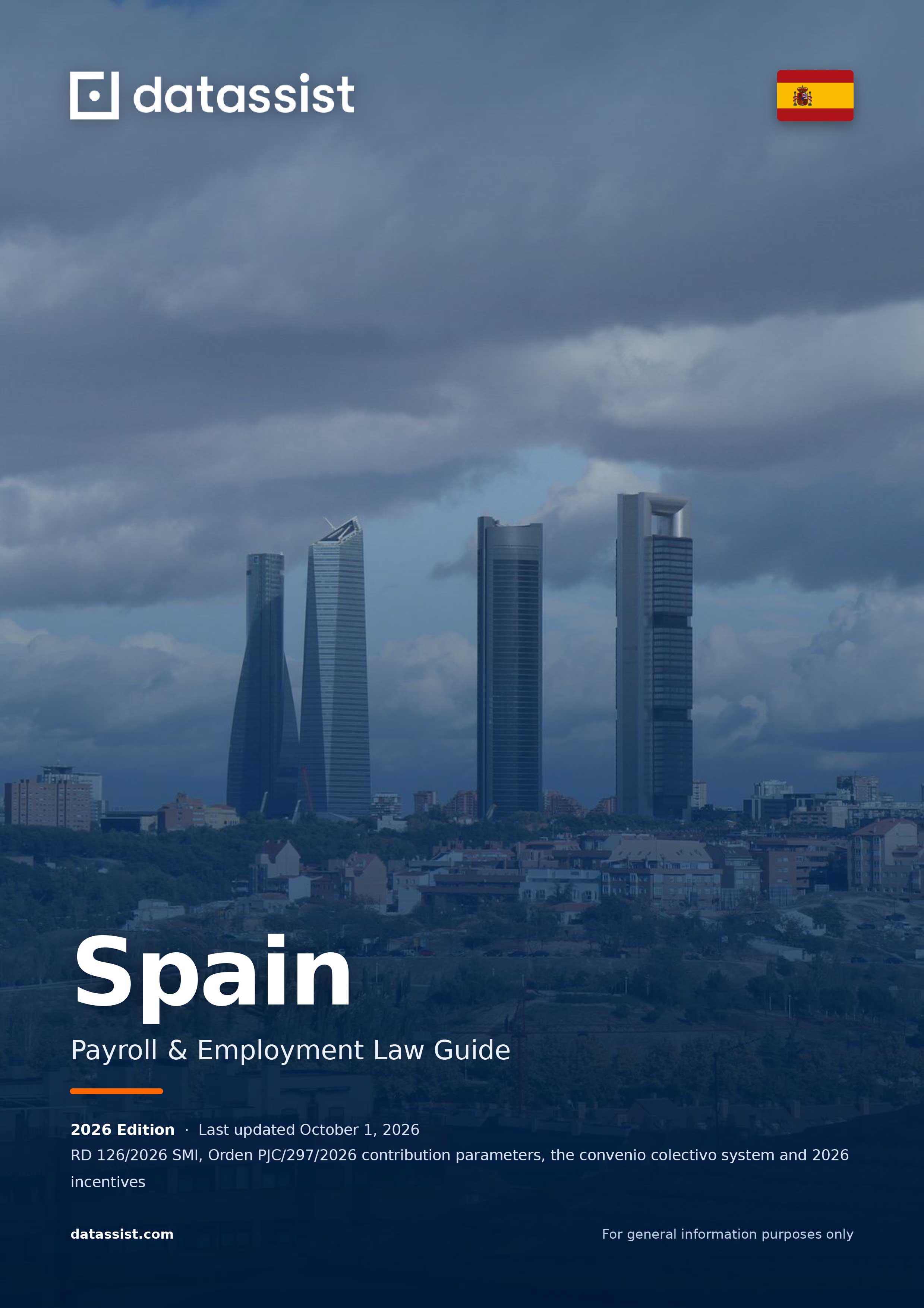
Spain Payroll & Employment Guide
This guide is written for employers incorporating a company in Spain, opening a branch, or hiring staff through an existing structure. It targets the finance, human resources and compliance teams that must run payroll, social security, employment law and work-permit processes inside one operating calendar. The SMI was set by a new Real Decreto, the contribution ceiling rose, the cuota de solidaridad on pay above that ceiling entered its second year of application, and the MEI rate increased again. At the same time the reduction of the working week to 37.5 hours was not enacted. That two-sided picture means the 2026 cost model is assembled from several instruments rather than a single announcement.
- 12
- pages
- 9
- chapters
- 2.340
- words
- EUR
- currency
At a glance
At a Glance
- 40 hours
- Statutory working week
- EUR 1,221 × 14
- 2026 SMI pay structure
- 30 days
- Minimum annual paid leave
- 28.30%
- Total common-contingencies rate
What's in the guide
9 chapters, 12 pages
The opening summary of each chapter is below. Full text, tables and rates are in the PDF.
Employer Structure & Contract Framework
Employer structure, registrations and the contract layer.
The employment obligation begins when the employer is registered with the TGSS and a CCC number is issued. Commercial registration and social security employer registration are separate steps, and no employee can enter the system without a CCC.
Working Time & Leave
Working time, leave and periodic payment rules.
Working time and rest are set by statute, while their monetary value is set by the convenio colectivo. There is no statutory premium for overtime or night work, so payroll must hold the statutory ceiling and the sector payment rule as separate parameters.
Tax & Social Security
Income tax, contributions and social security parameters.
IRPF has two components: the state scale and the regional scale each comunidad autónoma sets. What payroll applies is not their sum but an individually calculated withholding rate per employee. Contribution parameters come from the annual cotización order.
Payroll Operations
Payroll calendar, filings and record obligations.
Contribution reporting runs on the Sistema de Liquidación Directa model: the employer submits employee-level data, the TGSS calculates the contribution and returns it to the employer. The nómina must also itemise the contributions paid by the employer, and an accurate calculation can still attract a fine if the record or filing format is wrong.
Hiring & Termination
Onboarding, contracts, notice and termination controls.
Social security registration must be completed before work starts, and the content of the contract is filed with SEPE within 10 days. Termination is not a notification but a reasoned and formal act, and a ground not stated in the carta de despido cannot be argued later in court.
Pay & Benefits
Pay floors, additional payments and benefits.
The SMI is the absolute statutory floor, not the operative pay floor. The operative floor is the tablas salariales of the applicable convenio colectivo, graded by professional group, and in practice it sits clearly above the SMI. There is no statutory annual increase, increases come from the convenio's pay table.
Work Permits & Mobility
Local hiring, foreign workers and mobility rules.
EU, EEA and Swiss nationals need no work permit, for stays longer than 3 months they obtain an NIE and register with the Registro Central de Extranjeros. Third-country nationals are split between the general regime and the fast-track route of Ley 14/2013.
Practical Controls & Compliance Notes
Controls before first payroll and throughout the operation.
Pay scales, overtime premiums, night premiums, probation, resignation notice and sick-pay top-ups all change with the convenio colectivo. The applicable convenio is identified by activity, geography and time, more than five thousand convenios are in force, and an expired text stays in force until a new one is signed.
Incentives & Employer Support
2026 employer support and conditional incentive schemes.
Spain has no general contribution reduction, no minimum-wage subsidy and no additional-employment incentive. The framework created by RDL 1/2023 consists of target-group monthly bonificaciones in fixed euro amounts, what is reduced is an amount rather than a rate, and the weight sits on open-ended hiring.
This guide is for general information only; it is not legal advice or a complete statement of the law. The content reflects the legislation in force when it was prepared, and legislation changes. Always take country-specific professional advice on a concrete case.
With Datassist
Managing Spanish Payroll
Running payroll in Spain means getting three disciplines right at once: the wage floor set by the applicable convenio colectivo, the TGSS monthly contribution calendar, and the AEAT withholding regime. The three layers also move from different sources: one changes with a sectoral agreement renewal, one with the annual cotización order, and one with a regional law. Leaving a single parameter unrefreshed does not break the whole calculation, but it shifts the result by a material amount. Datassist operates your country payrolls, Spain included, under a single governance framework and tracks country parameters from current official sources.
Other countries
Other country guides

- 10 hours
- Daily ceiling with averaging
- EUR 12,348
- 2026 annual income tax allowance
Employer Structure · Working Time & Leave · Tax & Social Security · Payroll Operations
View Guide
- EUR 14.99
- Gross hourly minimum wage for age 21 and over
- 160 hours
- Statutory annual leave for a 40-hour week
Employer Structure · Working Time & Leave · Tax & Social Security · Payroll Operations
View Guide
- 40 hours
- Standard working week
- 4 weeks
- Minimum paid annual leave
Employer Structure · Working Time & Leave · Tax & Social Security · Payroll Operations
View Guide