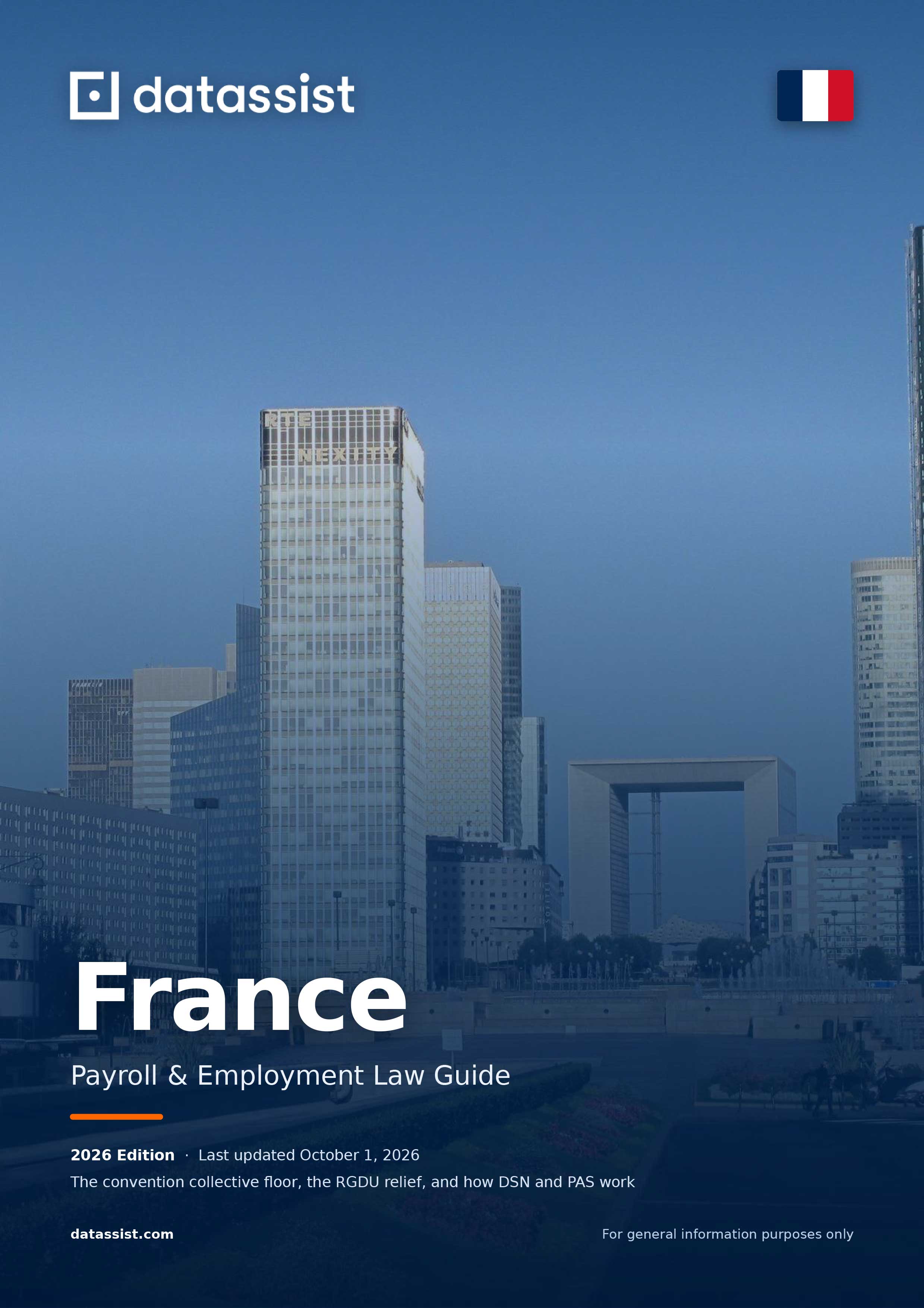
France Payroll & Employment Guide
This guide is for employers setting up a company in France, opening a branch, or moving an existing team into the country. It is a reference for HR, payroll and finance teams in day to day decisions. No rule applied in France can be verified from the Code du travail alone, so each section shows the statutory floor and the sector agreement layer separately. 2026 brought the broadest simplification of French employer contributions in a decade. The low wage band reliefs on sickness and family contributions, the bandeau, were removed on January 1, 2026 and replaced by a single general relief, the RGDU. The same year the SMIC changed twice, the first mandatory stage of electronic invoicing began, and the retirement age increase was suspended. These three alone make a payroll setup built on 2025 parameters produce wrong results in 2026.
- 12
- pages
- 9
- chapters
- 2.350
- words
- EUR
- currency
At a glance
At a Glance
- 35 hours
- Statutory working week
- EUR 1,867.02
- Monthly SMIC from 1 June 2026
- EUR 48,060
- 2026 annual PASS
- 3 SMIC
- RGDU eligibility ceiling
What's in the guide
9 chapters, 12 pages
The opening summary of each chapter is below. Full text, tables and rates are in the PDF.
Employer Structure & Contract Framework
Employer structure, registrations and the contract layer.
Any structure that employs staff must be registered as an employer with URSSAF before the employee starts work. Since 2023 formation runs through a single digital gateway, the guichet unique, and one filing reaches the trade register, the tax authority and the social security bodies. The legal form chosen determines the director's social security status and whether the director appears on payroll.
Working Time & Leave
Working time, leave and periodic payment rules.
Statutory working time in France is 35 hours per week. This is not a ceiling but the threshold at which overtime begins. Daily and weekly maximum hours and rest periods are public policy rules in the Code du travail. Leave, overtime premiums and sick pay top ups can be raised above the statutory floor by the convention collective.
Tax & Social Security
Income tax, contributions and social security parameters.
Income tax is collected at source by the employer through the prélèvement à la source, but the rate is notified by the tax authority, not the employer. Contributions are multi layered and most layers are indexed to the annual ceiling known as the PASS.
Payroll Operations
Payroll calendar, filings and record obligations.
French payroll rests on two documents that validate each other: the pay slip and the social filing. Since 2022 the pay slip is issued in a simplified format, the bulletin de paie clarifié. Social filings go through a single monthly file called the DSN, which is both the declaration and the basis for the contribution payment.
Hiring & Termination
Onboarding, contracts, notice and termination controls.
In France the open ended contract (CDI) is the rule and the fixed term contract (CDD) is the exception. The Code du travail sets a floor for probation and notice, the convention collective may change those periods and, for cadre staff, usually does. Termination procedure is formally strict and a procedural defect on its own gives rise to compensation.
Pay & Benefits
Pay floors, additional payments and benefits.
The statutory minimum wage in France is the SMIC, but the effective floor is usually the pay scale in the convention collective, and where that scale sits above the SMIC it must be applied. Some benefits are mandated by law, the others rest on contract, custom or an employer decision, and their exemption is generally limited by a cap.
Work Permits & Mobility
Local hiring, foreign workers and mobility rules.
The work authorisation regime in France rests on two separate logics. Nationals of the European Union, the European Economic Area and Switzerland move freely and need no work permit, filing obligations continue to apply. For third country nationals the employer obtains the authorisation. Temporary assignment falls under the détachement regime.
Practical Controls & Compliance Notes
Controls before first payroll and throughout the operation.
Most employer obligations in France are tied to headcount thresholds, and once a threshold is crossed the obligation arises automatically. Thresholds are calculated on monthly averages, so a temporary increase can also trigger them. The most frequent problem in audits is applying the wrong convention collective.
Incentives & Employer Support
2026 employer support and conditional incentive schemes.
Employer support in France falls into three layers: a general contribution relief tied to the wage band, contract based support for target groups, and exemptions tied to geographic zones. As a rule these do not stack. Before relief, employer contributions run at roughly 40% to 45% of gross pay and employee deductions at roughly 21% to 23%.
This guide is for general information only; it is not legal advice or a complete statement of the law. The content reflects the legislation in force when it was prepared, and legislation changes. Always take country-specific professional advice on a concrete case.
With Datassist
Managing French Payroll
French payroll is not a structure that can be built by reading a single piece of legislation. Identifying the correct convention collective, setting the RGDU parameters to the right year values, closing the DSN and PAS cycle against the CRM response file, and tracking threshold based obligations are four connected disciplines. Datassist runs all four layers as a single operation for employers with staff in France and reconciles the parameters against official sources in every payroll period. For companies still at the setup stage, it plans the path from choosing a legal form to filing the first DSN within the same framework.
Other countries
Other country guides

- 10 hours
- Daily ceiling with averaging
- EUR 12,348
- 2026 annual income tax allowance
Employer Structure · Working Time & Leave · Tax & Social Security · Payroll Operations
View Guide
- EUR 14.99
- Gross hourly minimum wage for age 21 and over
- 160 hours
- Statutory annual leave for a 40-hour week
Employer Structure · Working Time & Leave · Tax & Social Security · Payroll Operations
View Guide
- 40 hours
- Standard working week
- 4 weeks
- Minimum paid annual leave
Employer Structure · Working Time & Leave · Tax & Social Security · Payroll Operations
View Guide