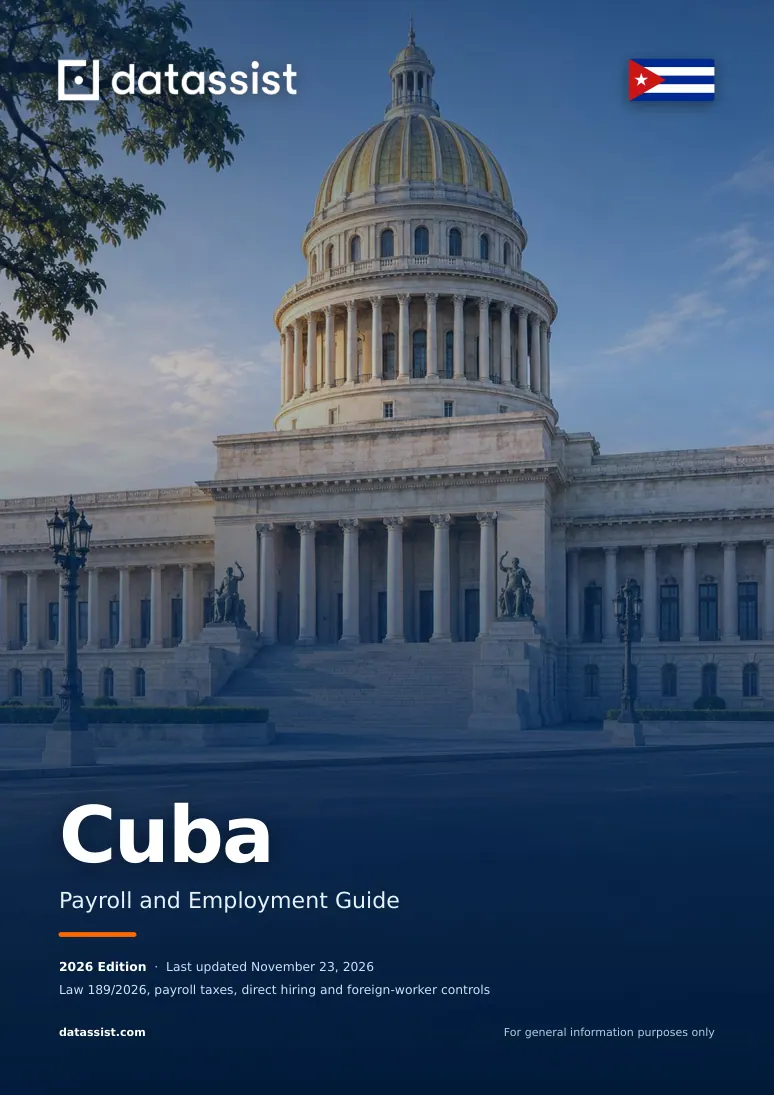
Cuba Payroll and Employment Guide
This guide is for finance, HR and payroll teams employing workers or assessing a local employment model in Cuba. The 2026 rules materially changed the Labour Code, direct hiring by foreign-investment entities, migration procedures and the national minimum wage.
- 12
- pages
- 9
- chapters
- 2.140
- words
- CUP
- currency
At a glance
At a Glance
- CUP 3,210
- National monthly minimum wage
- 40-44h
- Standard weekly range
- 14%
- Employer social security
- 5%
- Workforce-utilisation tax
What's in the guide
9 chapters, 12 pages
The opening summary of each chapter is below. Full text, tables and rates are in the PDF.
Company Formation and Business Environment
Employer structure, registrations and the contract layer.
Cuba's foreign-investment regime is approval-led. A project normally moves through MINCEX review, formal authorisation, notarial documents, Mercantile Registry entry and ONAT registration. The employer model must then be selected between authorised direct hiring and an MTSS-authorised employing entity.
Working Conditions and Leave Entitlements
Working time, leave and periodic payment rules.
Law 189/2026 sets the current working-time, overtime and annual-leave framework. Sick and maternity benefits remain coordinated with social-security legislation. Collective agreements remain important for schedules, probation length and pay arrangements.
Tax and Social Security
Income tax, contributions and social security parameters.
Employment income is subject to monthly progressive withholding. Employer social security and the workforce-utilisation tax are separate charges. The 2026 minimum wage is slightly below the monthly PIT exemption, so the two figures must not be treated as the same threshold.
Payroll Operations
Payroll calendar, filings and record obligations.
Salary is paid in CUP in arrears at least monthly. The employer must explain the amount and deductions and preserve the supporting audit trail. Tax and contribution payments generally follow the first 10 business days of the following month.
Hiring and Termination
Onboarding, contracts, notice and termination controls.
Employment contracts are generally written on paper or digitally, with a copy for each party. Fixed-term work is limited to statutory temporary cases. Probation and notice periods depend on the contract and role rather than one universal termination formula.
Wages and Benefits
Pay floors, additional payments and benefits.
Full-time subordinate pay cannot fall below CUP 3,210 per month. Cuba has no verified universal 13th salary. Results pay, incentive funds and profit distributions depend on the entity, approved scheme and collective agreement.
Visas and Work Permits
Local hiring, foreign workers and mobility rules.
The current sequence is normally work permit first, then the relevant DIMEC residence process. The sponsor must justify the role and monitor entry, residence, renewal and change-notification dates under the post-2026-11-01 migration regime.
Practical Notes and Compliance Risks
Controls before first payroll and throughout the operation.
Cuba's payroll file must reconcile the employer model, labour records, data transfers, payment route and sanctions screening. The 2026 rules permit more direct operation, but they do not remove local authorisations or cross-border banking constraints.
Incentives and Employer Support Schemes
2026 employer support and conditional incentive schemes.
Cuba's support framework is primarily investment- and inclusion-based rather than a broad payroll contribution rebate. Employer social security at 14% and workforce tax at 5% remain separate baseline liabilities unless a specific written regime applies.
This guide is for general information only; it is not legal advice or a complete statement of the law. The content reflects the legislation in force when it was prepared, and legislation changes. Always take country-specific professional advice on a concrete case.
With Datassist
Review your Cuba payroll framework with us.
Cuban payroll requires new Labour Code rules, monthly taxes, social contributions, migration dates and cross-border payment controls to run on one calendar. Datassist connects local-expert input to a common payroll process to support calculations, evidence and filing readiness.
Other countries
Other country guides
- ARS 398,800
- November monthly minimum wage
- 48h
- General maximum working week
Company Formation and Business Environment · Working Conditions and Leave Entitlements · Tax and Social Security · Payroll Operations · Hiring and Termination · Wages and Benefits · Visas and Work Permits · Practical Notes and Compliance Risks · Incentives and Employer Support Schemes
View Guide
- BRL 1,621
- National monthly minimum wage
- 44h
- General week through December 15
Company Formation and Business Environment · Working Conditions and Leave Entitlements · Tax and Social Security · Payroll Operations · Hiring and Termination · Wages and Benefits · Visas and Work Permits · Practical Notes and Compliance Risks · Incentives and Employer Support Schemes
View Guide
- VES 130
- Statutory monthly minimum wage
- 40h
- Maximum standard day-work week
Company Formation and Business Environment · Working Conditions and Leave Entitlements · Tax and Social Security · Payroll Operations · Hiring and Termination · Wages and Benefits · Visas and Work Permits · Practical Notes and Compliance Risks · Incentives and Employer Support Schemes
View Guide