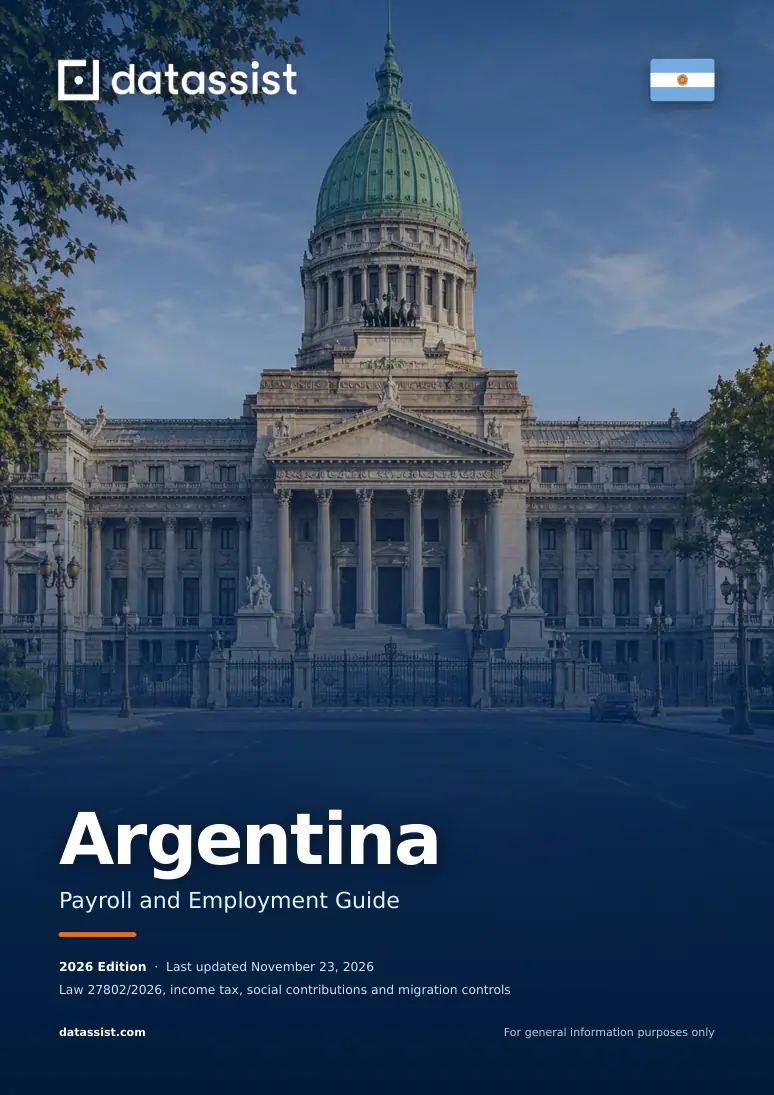
Argentina Payroll and Employment Guide
This guide is for finance, HR and payroll teams employing workers or evaluating a local employment model in Argentina. Monthly indexed tax and contribution values, collective agreements and the 2026 labour reform require an effective-date and sector control in every payroll cycle.
- 12
- pages
- 9
- chapters
- 2.114
- words
- ARS
- currency
At a glance
At a Glance
- ARS 398,800
- November monthly minimum wage
- 48h
- General maximum working week
- 17%
- Common employee social contributions
- 18%-20.4%
- Base employer statutory contribution range
What's in the guide
9 chapters, 12 pages
The opening summary of each chapter is below. Full text, tables and rates are in the PDF.
Company Formation and Business Environment
Employer structure, registrations and the contract layer.
Foreign investors generally enter on the same conditions as domestic investors, subject to sector-specific rules. Common employer structures include SA/SAU, SRL, SAS and a registered foreign branch. The local setup connects company registration and CUIT to ART, employer status and pre-start worker registration.
Working Conditions and Leave Entitlements
Working time, leave and periodic payment rules.
The general maximum remains 8 hours daily or 48 hours weekly. Law 27802/2026 permits written voluntary hour banks and averaged schedules, but it did not create a universal 12-hour ordinary day. Night work is limited to 7 hours, declared unhealthy work to 6 hours daily or 36 weekly, and overtime to 3 hours daily, 30 monthly and 200 yearly.
Tax and Social Security
Income tax, contributions and social security parameters.
Employment income tax is calculated cumulatively. November payroll uses the January-November scale and deductions, not the annual final figures. Employee social contributions are capped, while employer bases are generally uncapped and the rate depends on employer status.
Payroll Operations
Payroll calendar, filings and record obligations.
Monthly employees are paid at month-end within 4 working days. Weekly employees are paid within 3 working days. Notified employers validate payroll in Libro de Sueldos Digital and generate F.931 through Declaración en Línea.
Hiring and Termination
Onboarding, contracts, notice and termination controls.
The first 6 months of indefinite employment are probation. A collective agreement can extend the period for smaller employers. Fixed-term employment must be written, objectively justified and limited to 5 years. Exit treatment depends on reason, notice and current article 245 rules.
Wages and Benefits
Pay floors, additional payments and benefits.
The November minimum is ARS 398,800 monthly and ARS 1,994 hourly. It rises on 2026-12-01 to ARS 406,400 and ARS 2,032. Collective-agreement wages commonly exceed SMVM. SAC is a separate statutory half-year payment.
Visas and Work Permits
Local hiring, foreign workers and mobility rules.
The dependent-worker residence route is processed through RaDEX. The employer provides a certified pre-contract, CUIT and ARCA evidence and current RENURE registration. The electronic residencia precaria permits work while the application is pending.
Practical Notes and Compliance Risks
Controls before first payroll and throughout the operation.
Argentina payroll must align the employment contract, ARCA registration, ART, wage book, employee account and cross-border controls. The 2026 reform permits foreign-currency remuneration, but monetary wages still go to an account in the worker's name.
Incentives and Employer Support Schemes
2026 employer support and conditional incentive schemes.
Argentina's 2026 support landscape combines targeted hiring relief, contribution-base deductions and temporary regularisation. Every mechanism has worker, employer and timing conditions. FAL is a new funding allocation from December, not a recurring wage subsidy.
This guide is for general information only; it is not legal advice or a complete statement of the law. The content reflects the legislation in force when it was prepared, and legislation changes. Always take country-specific professional advice on a concrete case.
With Datassist
Review your Argentina payroll framework with us.
Argentina payroll requires monthly indexed values, collective rules, ARCA filings, ART, immigration and payment controls to operate on one calendar. Datassist connects local-expert input to a common payroll process to support calculations, digital reporting and audit evidence.
Other countries
Other country guides
- BRL 1,621
- National monthly minimum wage
- 44h
- General week through December 15
Company Formation and Business Environment · Working Conditions and Leave Entitlements · Tax and Social Security · Payroll Operations · Hiring and Termination · Wages and Benefits · Visas and Work Permits · Practical Notes and Compliance Risks · Incentives and Employer Support Schemes
View Guide
- CUP 3,210
- National monthly minimum wage
- 40-44h
- Standard weekly range
Company Formation and Business Environment · Working Conditions and Leave Entitlements · Tax and Social Security · Payroll Operations · Hiring and Termination · Wages and Benefits · Visas and Work Permits · Practical Notes and Compliance Risks · Incentives and Employer Support Schemes
View Guide
- VES 130
- Statutory monthly minimum wage
- 40h
- Maximum standard day-work week
Company Formation and Business Environment · Working Conditions and Leave Entitlements · Tax and Social Security · Payroll Operations · Hiring and Termination · Wages and Benefits · Visas and Work Permits · Practical Notes and Compliance Risks · Incentives and Employer Support Schemes
View Guide