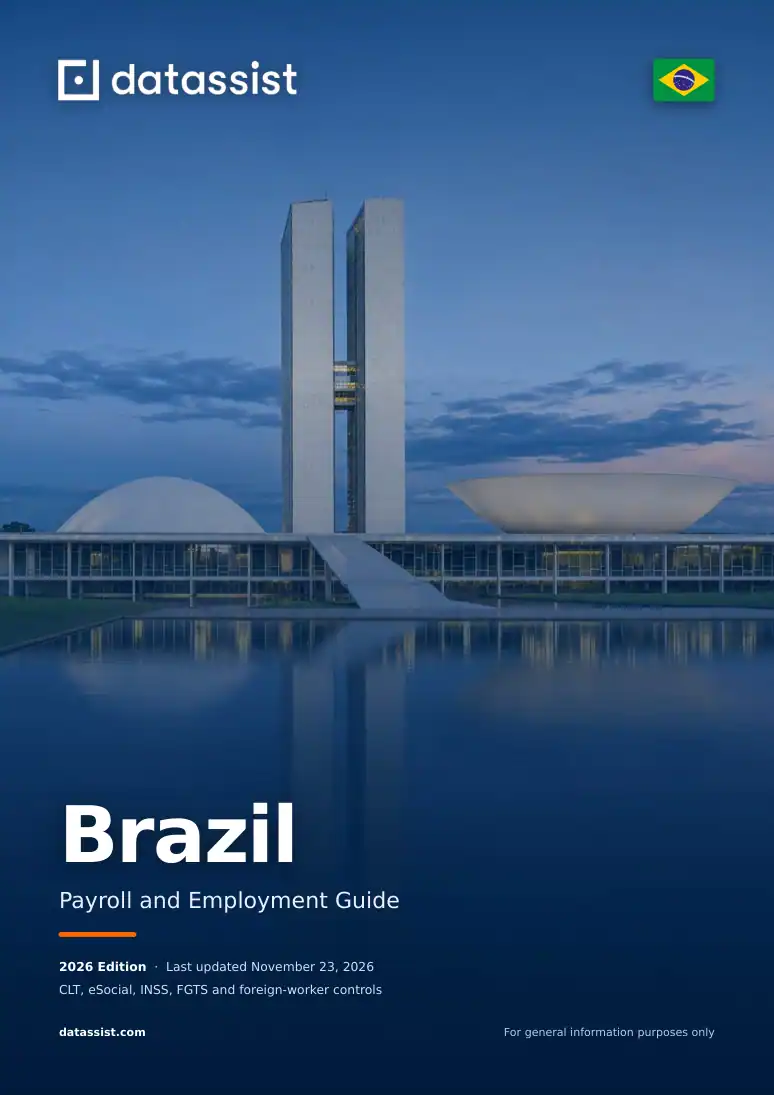
Brazil Payroll and Employment Guide
This guide is for finance, HR and payroll teams employing workers or building a local payroll model in Brazil. Federal rules interact with state wage floors, collective agreements, establishment classifications and digital reporting, so each payroll file needs a controlled legal and tax profile.
- 12
- pages
- 9
- chapters
- 2.245
- words
- BRL
- currency
At a glance
At a Glance
- BRL 1,621
- National monthly minimum wage
- 44h
- General week through December 15
- 20%
- General employer CPP
- 8%
- Standard employer FGTS
What's in the guide
9 chapters, 12 pages
The opening summary of each chapter is below. Full text, tables and rates are in the PDF.
Company Formation and Business Environment
Employer structure, registrations and the contract layer.
A Brazilian limited company can be owned by foreign persons and is commonly used as the local employer. Operating through a foreign branch requires prior Federal Executive authorisation. Employer setup connects REDESIM and CNPJ registration to eSocial establishment and employee events.
Working Conditions and Leave Entitlements
Working time, leave and periodic payment rules.
Constitutional Amendment 141/2026 keeps the general ceiling at 8 hours daily and 44 hours weekly through 2026-12-15. From 2026-12-16, the general week becomes 42 hours with 2 paid weekly rest days. A further reduction to 40 hours begins on 2027-12-16 without salary reduction.
Tax and Social Security
Income tax, contributions and social security parameters.
Monthly payroll applies the ordinary IRRF table and then the 2026 reduction. Employee INSS is progressive, while employer CPP, RAT/FAP and third-party levies are calculated separately. FGTS is an employer deposit rather than an employee deduction.
Payroll Operations
Payroll calendar, filings and record obligations.
Monthly salary is generally due by the fifth business day of the following month. eSocial is the source for remuneration, payment, closing and FGTS data. DCTFWeb filing can occur after the normal payment day, so payroll closing must still support payment by the 20th.
Hiring and Termination
Onboarding, contracts, notice and termination controls.
Indefinite employment is the default. Written probation is capped at 90 days and ordinary fixed-term employment at 2 years for statutory temporary purposes. Exit calculations depend on termination ground and must be paid with the documents within 10 calendar days.
Wages and Benefits
Pay floors, additional payments and benefits.
The national floor is BRL 1,621 per month, subject to higher state or collective floors. Employees also receive statutory 13th salary and vacation pay. Transport and food benefits follow separate eligibility and payroll-character rules.
Visas and Work Permits
Local hiring, foreign workers and mobility rules.
The standard employment-contract route uses RN 02/2017. The Brazilian employer seeks residence authorisation in MigranteWeb, followed by VITEM V abroad where applicable and Federal Police registration after entry.
Practical Notes and Compliance Risks
Controls before first payroll and throughout the operation.
Brazilian payroll depends on aligned source data across contract, eSocial, FGTS Digital, DCTFWeb and employee payment records. Cross-border HR systems also require an LGPD transfer mechanism, while provider service invoices follow the changing NFS-e framework.
Incentives and Employer Support Schemes
2026 employer support and conditional incentive schemes.
Brazil has targeted payroll and employee-benefit mechanisms rather than one universal employer subsidy. The 2026 CPRB transition applies only to eligible opting sectors. PAT can support food benefits, while disability and apprenticeship rules are workforce obligations.
This guide is for general information only; it is not legal advice or a complete statement of the law. The content reflects the legislation in force when it was prepared, and legislation changes. Always take country-specific professional advice on a concrete case.
With Datassist
Review your Brazil payroll framework with us.
Brazilian payroll requires tax bands, establishment rates, eSocial events, FGTS, collective rules and immigration controls to operate on one calendar. Datassist connects local-expert input to a common payroll process to support calculations, digital reporting and audit evidence.
Other countries
Other country guides
- ARS 398,800
- November monthly minimum wage
- 48h
- General maximum working week
Company Formation and Business Environment · Working Conditions and Leave Entitlements · Tax and Social Security · Payroll Operations · Hiring and Termination · Wages and Benefits · Visas and Work Permits · Practical Notes and Compliance Risks · Incentives and Employer Support Schemes
View Guide
- CUP 3,210
- National monthly minimum wage
- 40-44h
- Standard weekly range
Company Formation and Business Environment · Working Conditions and Leave Entitlements · Tax and Social Security · Payroll Operations · Hiring and Termination · Wages and Benefits · Visas and Work Permits · Practical Notes and Compliance Risks · Incentives and Employer Support Schemes
View Guide
- VES 130
- Statutory monthly minimum wage
- 40h
- Maximum standard day-work week
Company Formation and Business Environment · Working Conditions and Leave Entitlements · Tax and Social Security · Payroll Operations · Hiring and Termination · Wages and Benefits · Visas and Work Permits · Practical Notes and Compliance Risks · Incentives and Employer Support Schemes
View Guide