Austria Payroll & Employment Guide
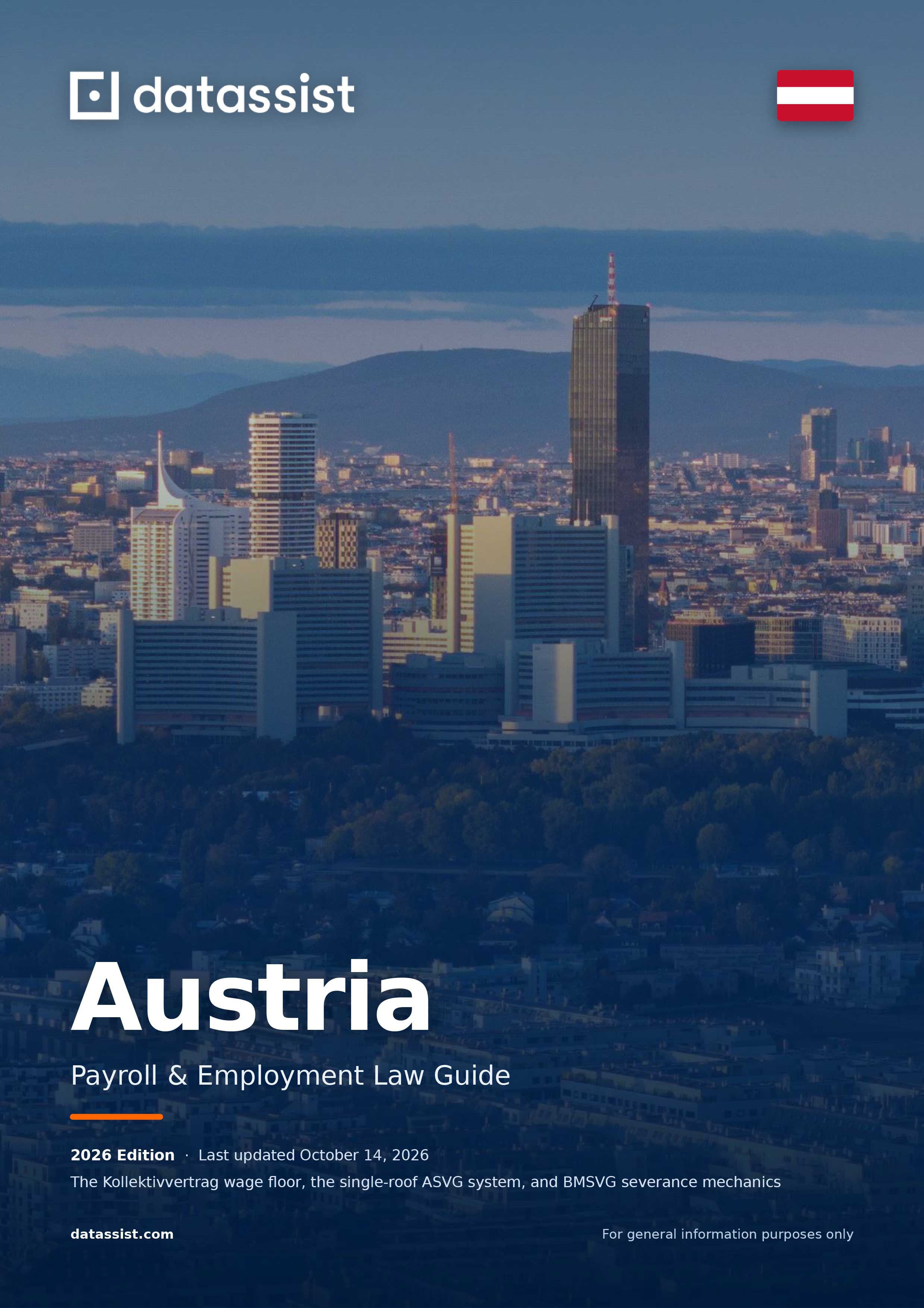
This guide is for employers setting up a company in Austria, opening a branch, or moving an existing team into the country. It is a reference for HR, payroll and finance teams in day to day decisions. Austria is an EU member state, and the defining feature of its payroll structure, unlike Germany or the Netherlands, is that there is no statutory minimum wage law. Pay floors come entirely from sector Kollektivverträge, that is branch collective agreements, and roughly 98 percent of employees are covered by one. Social security is also organised differently from Germany's five separate branches, Austria runs everything under one umbrella law, ASVG, and the employer pays all contributions in a single transfer to ÖGK. Every section below states the statutory floor clearly and notes that checking the applicable collective agreement is the first step in any payroll setup. 2026 is a year in which three separate changes land at once in Austrian payroll. Income tax bracket thresholds were shifted upward by two thirds of the official 2026 inflation estimate of 2.6 percent, roughly 1.73 percent. The Basisförderung apprenticeship subsidy for training companies was cut to only 75 percent of the previous calculation base for training years ending from July 1, 2026. The same year, the Ausgleichstaxe amounts owed for every unfilled disability employment quota position were also updated. These three alone are enough to make a payroll setup built on 2025 parameters produce wrong results in 2026.
- 14
- pages
- 9
- chapters
- 2.245
- words
- EUR
- currency
At a glance
At a Glance
- No statutory minimum
- Roughly 450 sector Kollektivverträge set the real wage floor
- 0 to 55%
- Income tax brackets, top rate sunsets in 2029
- EUR 10,000
- GmbH minimum share capital since 2024
- 1.53%
- Employer BMSVG severance-fund contribution
What's in the guide
9 chapters, 14 pages
The opening summary of each chapter is below. Full text, tables and rates are in the PDF.
Setting Up and Doing Business
Legal form choices, the registration chain and the legal framing of the EOR alternative.
Any structure employing staff in Austria must hold legal personality through registration in the Firmenbuch, the commercial register, and must have notified ÖGK before the first employee starts work. Foreign investors most commonly choose the GmbH, whose minimum share capital was cut from EUR 35,000 to EUR 10,000 starting in 2024. FlexKapG, added the same year, is a more flexible alternative to the GmbH for venture capital structures. Any business carrying out commercial activity automatically becomes a member of WKO, the Wirtschaftskammer Österreich, and that membership is also the basis for determining which Kollektivvertrag applies.
Working Conditions and Leave
Maximum working time, rest, annual leave and sick leave rules.
The framework for working time, rest and leave is the Arbeitszeitgesetz (AZG). Normal working time is 8 hours a day and 40 hours a week, a Kollektivvertrag can extend the daily normal hours to 10 and, in certain cases, the weekly limit to 50 or 48 hours, but the average always stays at 40 hours a week. The maximum working time is 12 hours a day and 60 hours a week, and average weekly hours over the 17 week reference period, extendable to 26 or 52 weeks by a Kollektivvertrag, cannot exceed 48 hours.
Tax and Social Security
Income tax brackets, the 2026 bracket shift and social security thresholds.
Income tax, Lohnsteuer, is withheld at source and the employer files it with the Finanzamt. The 2026 tariff has six brackets, and the top rate of 55 percent is a temporary surcharge running from 2016 to 2029, after which it reverts to 50 percent. Bracket thresholds were shifted upward in 2026 by two thirds of the official inflation estimate of 2.6 percent, roughly 1.73 percent. Unlike Germany's five separate branches, social security sits under one umbrella law, ASVG, and the employer pays all contributions in a single transfer to ÖGK.
Payroll Operations
ELDA reporting, the Anmeldung timing and record retention periods.
Payroll runs in EUR, and monthly payroll is the common model in the private sector. All social security filings run through ELDA, the Elektronischer Datenaustausch mit den Sozialversicherungsträgern, to ÖGK, and a filing made outside this channel is not valid. Unlike Germany's 6 week Betriebsnummer tolerance, Austria requires at least a minimum Anmeldung data set to be filed with ÖGK before the employee starts work.
Hiring and Termination
Probation, notice periods, dismissal procedure and the Abfertigung Neu severance system.
For a new hire, the employer must already have filed the Anmeldung with ÖGK before work starts, failing to file in advance counts as Sozialbetrug, meaning undeclared work, and carries a serious administrative penalty. The probation period, Probemonat, is capped at 1 month, can be shortened by a Kollektivvertrag but cannot be extended by individual contract, and runs 3 months for apprentices. Severance pay runs on the Abfertigung Neu (BMSVG) system, which has no general equivalent in Germany, under which the employer pays 1.53 percent of pay every month into the employee's chosen BV-Kasse for every employment relationship starting after July 1, 2002, for all employees.
Compensation and Benefits
Where the pay floor actually comes from, 13th and 14th salary taxation and benefit exemptions.
Austria has no statutory minimum wage law. The wage floor comes entirely from sector Kollektivverträge, and roughly 98 percent of employees are covered by one. A 2017 agreement between ÖGB and WKO recommends a monthly gross floor of at least EUR 1,500 in every new or renewed Kollektivvertrag, but this is not law, it is a non binding statement of intent between the social partners. The 13th and 14th salary, Urlaubsgeld and Weihnachtsgeld, are not set in law but are de facto universal through Kollektivverträge.
Visas and Work Permits
EU free movement, the Rot-Weiß-Rot Card points system and the EU Blue Card threshold.
Nationals of the EU, the EEA and Switzerland can work in Austria without a work permit, they only need a residence registration, Anmeldebescheinigung. Third country nationals go through the points based Rot-Weiß-Rot Card system, which requires at least 55 points out of 90. There is no general national salary threshold, the gross pay must meet the level set by the applicable Kollektivvertrag and be found adequate by AMS.
Practical Notes and Common Pitfalls
Collective agreement primacy, the disability employment quota and the Ausgleichstaxe.
Every statutory figure in this guide is a floor, not a ceiling. In practice, the Kollektivvertrag that applies to the employee is what governs, and it almost always offers better terms than the law. The first question in any payroll setup is always which Kollektivvertrag applies to this employer and employee, which is determined through WKO branch membership.
Incentives and Employer Support Schemes
AMS support schemes, Kurzarbeit and the 2026 change to the apprenticeship subsidy.
The standard employer burden runs to roughly 21 percent across the social security branches, 1.53 percent for the BMSVG severance contribution, 3.70 percent for the Dienstgeberbeitrag, 0.31 to 0.40 percent for the DZ depending on the Bundesland, and 3.00 percent for the Kommunalsteuer, adding up to roughly 29 to 30 percent of gross pay in total. Austria is an EU member state and has no Gulf style localisation quota, which would conflict with EU free movement and non discrimination principles. There is also no horizontal, automatic contribution relief system comparable to Turkey's SGK incentive catalogue, support here is case by case and targeted at specific groups.
This guide is for general information only; it is not legal advice or a complete statement of the law. The content reflects the legislation in force when it was prepared, and legislation changes. Always take country-specific professional advice on a concrete case.
With Datassist
Managing Austria Payroll
No statutory minimum wage, roughly 450 sector collective agreements that set the real pay floor and overtime premiums, a BMSVG portable severance-fund contribution running alongside payroll, and ÖGK registration due before an employee's first day rather than after all have to run on one coordinated calendar. Datassist helps international employers manage Austrian payroll and employment processes from a single center, reconciling the parameters against official sources in every payroll period.
Other countries
Other country guides
- 10 hours
- Daily ceiling with averaging
- EUR 12,348
- 2026 annual income tax allowance
Employer Structure · Working Time & Leave · Tax & Social Security · Payroll Operations
View Guide
- EUR 14.99
- Gross hourly minimum wage for age 21 and over
- 160 hours
- Statutory annual leave for a 40-hour week
Employer Structure · Working Time & Leave · Tax & Social Security · Payroll Operations
View Guide
- 40 hours
- Standard working week
- 4 weeks
- Minimum paid annual leave
Employer Structure · Working Time & Leave · Tax & Social Security · Payroll Operations
View Guide