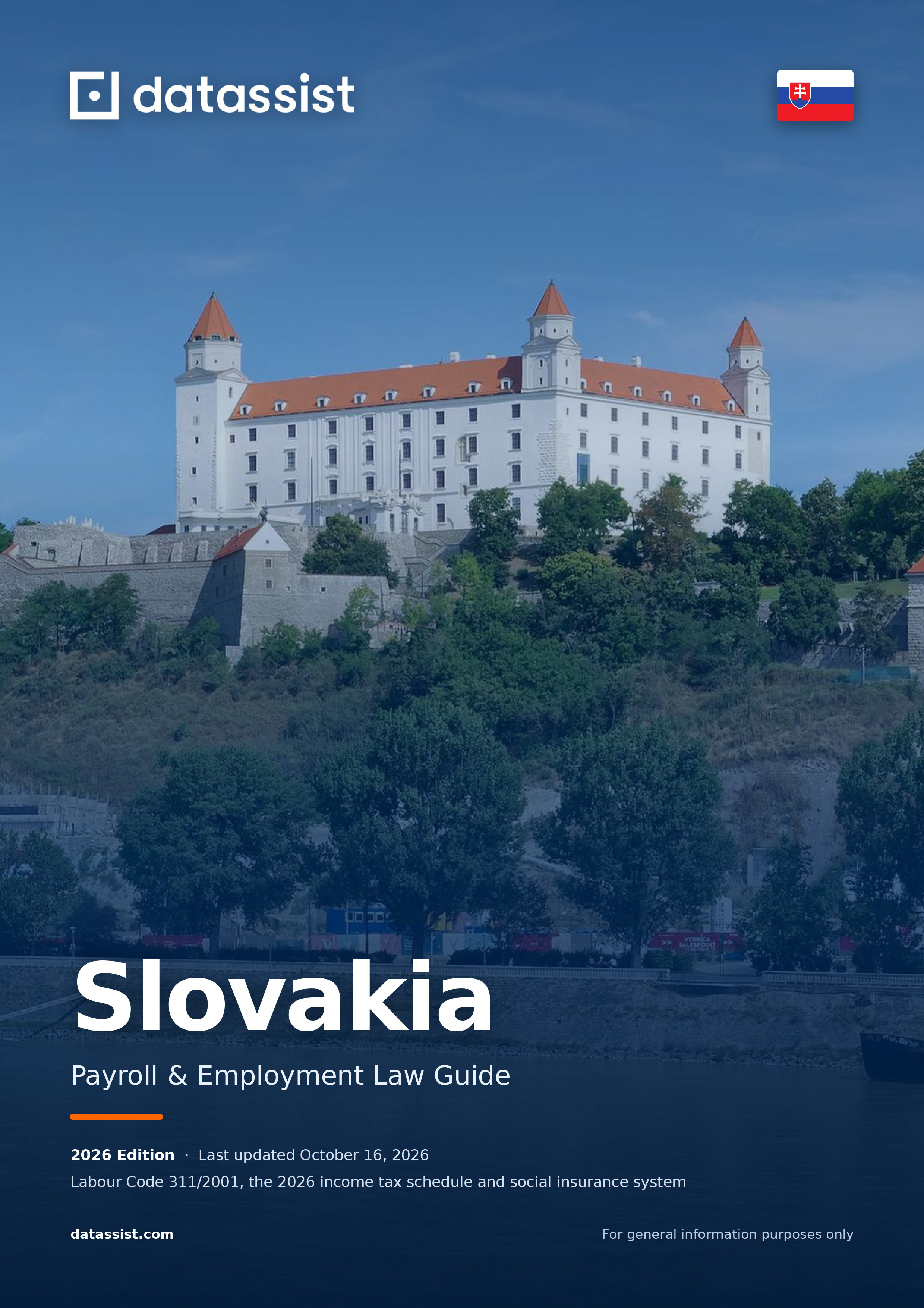
Slovakia Payroll & Employment Guide
This guide is for employers engaging staff through a Slovak entity or managing payroll across multiple countries. It explains the general private-sector rules as of October 16, 2026. Collective agreements, sector, employee status, disability, cross-border work and the foreign-worker category can change the result.
- 12
- pages
- 9
- chapters
- 2.346
- words
- EUR
- currency
At a glance
At a Glance
- 915 EUR
- 2026 statutory monthly minimum wage
- 9.4%
- Standard employee social insurance
- 25.2%
- Standard employer social insurance
- 14 days
- Employer-funded sickness period from 2026
What's in the guide
9 chapters, 12 pages
The opening summary of each chapter is below. Full text, tables and rates are in the PDF.
Company Formation and Business Environment
Employer structure, registrations and the contract layer.
The s.r.o. is the most common limited-liability form in Slovakia. Commercial Register entry, tax registration, the public electronic mailbox and social and health insurance registrations for the first employee should be managed as one operating plan.
Working Conditions and Leave Entitlements
Working time, leave and periodic payment rules.
Labour Code 311/2001 sets the general working week at 40 hours. The shift pattern and hazardous work can produce a shorter weekly limit. Working time, overtime, night work and leave records must remain audit-ready.
Tax and Social Security
Income tax, contributions and social security parameters.
Employment income is taxed under a four-bracket progressive schedule in 2026. Social insurance and health insurance are paid to separate systems with different assessment-base rules. Both systems must be considered for a standard employee.
Payroll Operations
Payroll calendar, filings and record obligations.
Pay conditions must appear in the written contract or an incorporated collective agreement. Pay is delivered on the agreed pay date, and the employee receives a written or agreed electronic statement of accruals, deductions and total employer cost.
Hiring and Termination
Onboarding, contracts, notice and termination controls.
The employment contract must be written and state the role, workplace, start date and pay conditions. Fixed-term employment should remain exceptional. The general limit for the same work is 2 years with no more than 2 extensions or renewals in that period.
Wages and Benefits
Pay floors, additional payments and benefits.
From January 1, 2026, the general monthly minimum wage is EUR 915 and the hourly amount for a 40-hour week is EUR 5.259. Where a collective agreement does not set pay conditions, the job's degree of difficulty creates an additional minimum entitlement.
Visas and Work Permits
Local hiring, foreign workers and mobility rules.
EU, EEA and Swiss nationals can access the labour market without a work permit, while residence and information formalities remain. For a third-country national, the route depends on the role and employee category.
Practical Notes and Compliance Risks
Controls before first payroll and throughout the operation.
The most common Slovak payroll risk is a mismatch in dates or pay components between the contract, social insurance, health insurance and tax records. A single employee data card should be created before the start date.
Incentives and Employer Support Schemes
2026 employer support and conditional incentive schemes.
Slovak employer support usually requires a suitable candidate, a new job, a prior written agreement with the labour office and a retention commitment. A subsidy should not be treated as a firm payroll receivable before approval.
This guide is for general information only; it is not legal advice or a complete statement of the law. The content reflects the legislation in force when it was prepared, and legislation changes. Always take country-specific professional advice on a concrete case.
With Datassist
Managing Slovak Payroll
Slovak payroll requires the tax brackets, two insurance systems, the 2026 sickness rule and the employee lifecycle to run on one control calendar. Datassist combines local payroll data with central approvals and reporting for multi-country teams.
Other countries
Other country guides
- 10 hours
- Daily ceiling with averaging
- EUR 12,348
- 2026 annual income tax allowance
Employer Structure · Working Time & Leave · Tax & Social Security · Payroll Operations
View Guide
- EUR 14.99
- Gross hourly minimum wage for age 21 and over
- 160 hours
- Statutory annual leave for a 40-hour week
Employer Structure · Working Time & Leave · Tax & Social Security · Payroll Operations
View Guide
- 40 hours
- Standard working week
- 4 weeks
- Minimum paid annual leave
Employer Structure · Working Time & Leave · Tax & Social Security · Payroll Operations
View Guide