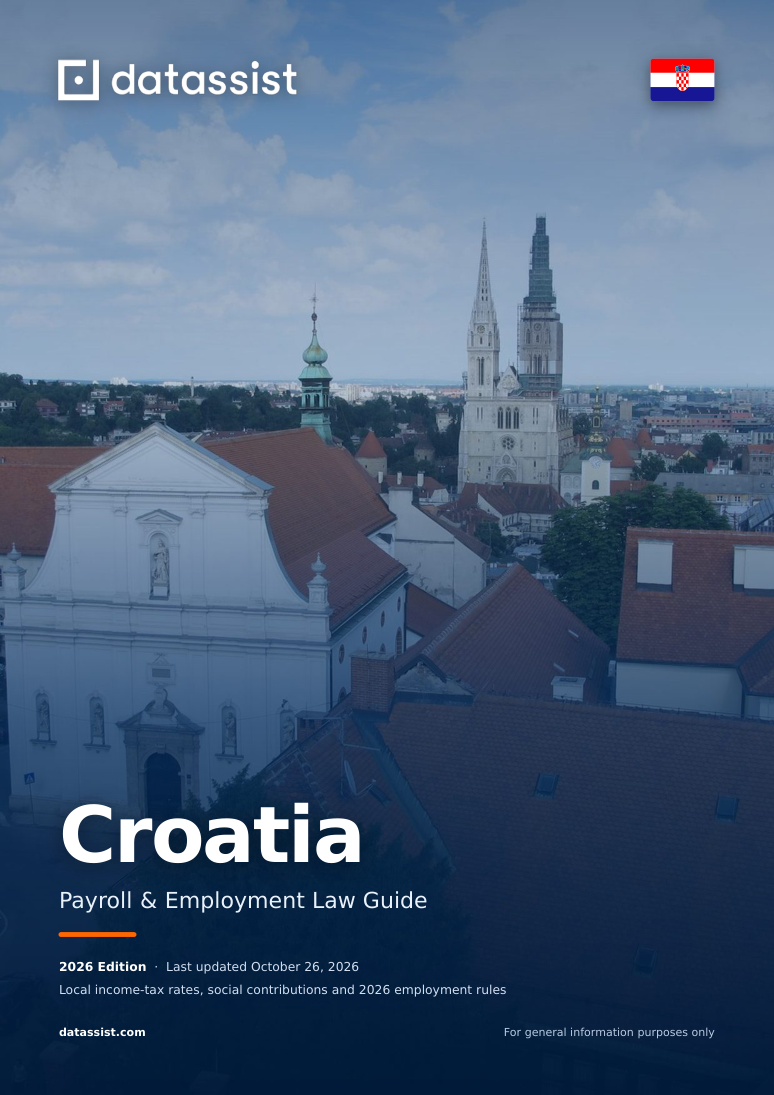
Croatia Payroll & Employment Guide
This guide is for employers engaging staff through a Croatian entity or managing Croatian payroll within a multi-country operation. It reflects general private-sector rules as of October 26, 2026. Income-tax rates depend on the employee's local place of residence, while sectoral collective agreements can change some pay and working conditions.
- 13
- pages
- 9
- chapters
- 2.594
- words
- EUR
- currency
At a glance
At a Glance
- €1,050
- 2026 statutory monthly minimum wage
- 40h
- Maximum standard working week
- 20%
- Standard employee pension contribution
- 16.5%
- Standard employer health contribution
What's in the guide
9 chapters, 13 pages
The opening summary of each chapter is below. Full text, tables and rates are in the PDF.
Company Formation and Business Environment
Employer structure, registrations and the contract layer.
The legal form most commonly used by foreign investors is the limited liability company, or d.o.o. Incorporation does not complete the employer registrations automatically. After Court Register entry and allocation of an OIB, the bank, HZMO, HZZO and Tax Administration steps must be handled separately.
Working Conditions and Leave Entitlements
Working time, leave and periodic payment rules.
Full-time work is capped at 40 hours a week. Overtime can bring total work to 50 hours a week. Annual overtime is generally limited to 180 hours, although a collective agreement can raise the limit to 250 hours.
Tax and Social Security
Income tax, contributions and social security parameters.
Croatia does not apply one national percentage to employment income. The lower and higher rates are set by the municipality or city of the employee's residence within statutory ranges. Payroll must use the local authority and personal-allowance information recorded on the tax card.
Payroll Operations
Payroll calendar, filings and record obligations.
Salary is calculated monthly and paid by the 15th day of the following month unless another binding instrument sets a different date. Income tax is calculated, withheld and paid when salary is paid. Contributions fall due with salary.
Hiring and Termination
Onboarding, contracts, notice and termination controls.
A written employment contract or written confirmation must be provided before work starts. Without the written document, the relationship may be presumed to be indefinite. A fixed-term contract needs an objective reason. The general limit is 3 successive contracts and 3 years in total.
Wages and Benefits
Pay floors, additional payments and benefits.
There is no general statutory annual salary increase or private-sector 13th salary. A bonus, Christmas award, holiday allowance or other additional payment can arise from a collective agreement, work rules, employment contract or employer decision.
Visas and Work Permits
Local hiring, foreign workers and mobility rules.
EEA and Swiss nationals may work without a work permit or work-registration certificate. Temporary stay must be registered after 3 months. A worker posted through an EEA or Swiss employer needs an A1 certificate and a posting declaration before work begins.
Practical Notes and Compliance Risks
Controls before first payroll and throughout the operation.
A common Croatian payroll failure is to process local income tax, collective-agreement coverage, employee status and leave through one national default. Residence, workplace, sector, tax card and insurance status should be verified together during onboarding.
Incentives and Employer Support Schemes
2026 employer support and conditional incentive schemes.
The standard employer health contribution is 16.5%. A person who is eligible and hired for the first time under an indefinite contract can generate a 1-year exemption from that contribution. The employer should retain the HZMO first-employment confirmation.
This guide is for general information only; it is not legal advice or a complete statement of the law. The content reflects the legislation in force when it was prepared, and legislation changes. Always take country-specific professional advice on a concrete case.
With Datassist
Running payroll and employment operations in Croatia
Employing people in Croatia means applying the rules in this guide every payroll period: tracking local income-tax rates, filing social security declarations, paying salaries, managing leave and calculating termination payments. Datassist teams work to help you manage this process from a single point in Turkey.
Other countries
Other country guides
- 10 hours
- Daily ceiling with averaging
- EUR 12,348
- 2026 annual income tax allowance
Employer Structure · Working Time & Leave · Tax & Social Security · Payroll Operations
View Guide
- EUR 14.99
- Gross hourly minimum wage for age 21 and over
- 160 hours
- Statutory annual leave for a 40-hour week
Employer Structure · Working Time & Leave · Tax & Social Security · Payroll Operations
View Guide
- 40 hours
- Standard working week
- 4 weeks
- Minimum paid annual leave
Employer Structure · Working Time & Leave · Tax & Social Security · Payroll Operations
View Guide