
Datassist MR (Monthly Review) is a monthly newsletter focused on the Employer Market, summarizing developments in specific areas such as compensation, payroll, employee benefits, and HR technologies in light of the economic outlook for CEOs, CFOs, and CHROs.
Highlights from the October issue:
- How Much Real Work Do AI Agents Actually Complete?
- Microsoft Offers "Voluntary Exit" to 60,000 Employees
- A New Era in the Tech Labor Market
- The AI Skills Gap: A Training Problem or a Planning Crisis?
- Employees Are Ready to Fund Their Own Training
- AI Is Splitting HR Into Two Archetypes
- Japan's Aging Workforce
- Google's AI Choice for Schools
- Private Employers Added 86,000 Jobs in October
- Base Pay Growth Was Little Changed in October
🇪🇺 Europe’s Labour Cost Equation: Wages, On-Costs and the 2026 Slowdown
Euro area labour cost growth is cooling: 3.1% in Q2 2026, down from 3.6% a year earlier. But the average hides what actually shapes a payroll budget. Our new Special Report breaks down Eurostat’s latest data:
- An hour of labour costs €12.0 in Bulgaria and €56.8 in Luxembourg, a 4.7x gap
- Employer on-costs range from 4.8% (Romania) to 32.3% (France) of total labour cost
- In late 2025, non-wage costs grew up to 1.4 points faster than wages in the euro area. By Q2 2026 the gap had closed
- Growth slowed in Germany, Italy, the Netherlands and Poland, and accelerated in France and Spain
🦾 How Much Real Work Do AI Agents Actually Complete?
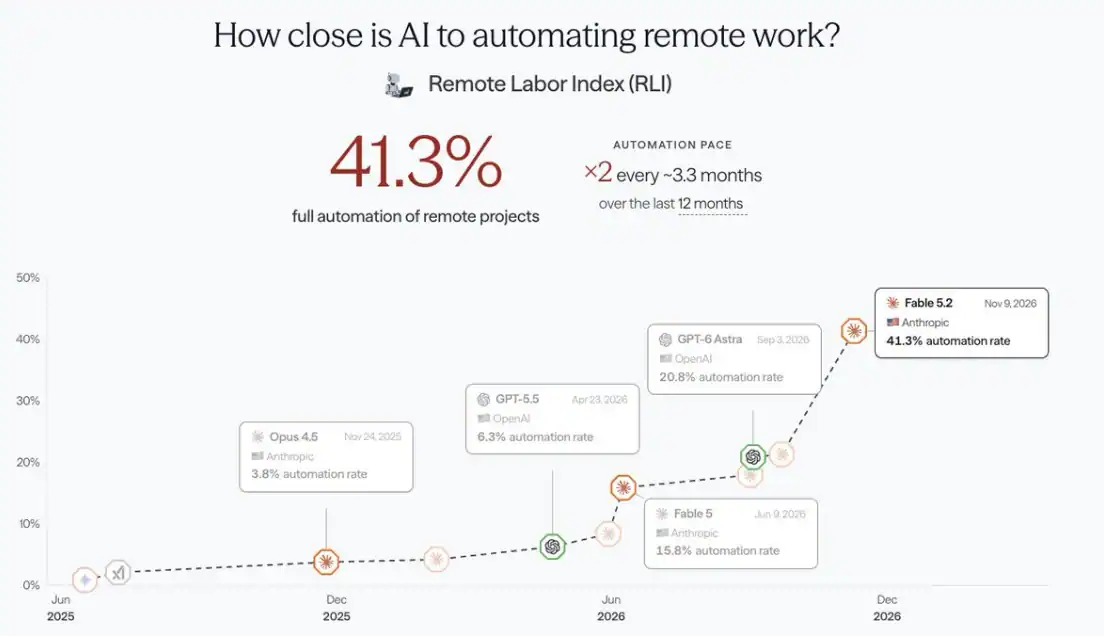
How far can AI agents run professional work on their own? The Remote Labor Index (RLI) measures how well AI systems complete real-world work that has economic value.
- Fable 5.2: 41.30%
- Opus 5.5: 21.25%
- GPT 6 Astra: 20.83%
The automation rate is the share of projects completed by AI that meet at least the same quality standard as professional human output. Fable 5.2's 41.30% rate therefore means it produced client-acceptable output in roughly 41% of the projects tested.
AI agents are not yet able to take on professional work end to end on their own:
- 45.6%: Output below professional quality standards.
- 35.7%: Incomplete or unfinished deliverables.
- 17.6%: Technical problems and broken file formats.
- 14.8%: Visual or logical inconsistencies across files.
Progress in AI is not only about performing specific tasks but also about delivering work end to end.
For HR and payroll operations in particular, when will AI move beyond supporting processes to completing specific ones independently while maintaining quality standards?
As things stand today, human expertise is still critical.
(Source: Scale Labs)
🔴 Microsoft Offers "Voluntary Exit" to 60,000 Employees
Microsoft has taken a new step to reduce headcount at a time when it is ramping up AI investment. The company is offering a severance package to about 60,000 employees worldwide in exchange for leaving voluntarily.
Announced on October 26, 2026, the program, called the Voluntary Exit Offer, covers about 27% of the 223,000-person global workforce Microsoft reported as of June 30, 2026.
The company plans a $175 billion capital expenditure budget for calendar year 2026. A large share of this spending goes to AI infrastructure, data centers and chips.
(Source: Investing)
💻 A New Era in the Tech Labor Market
As AI's effects on the labor market become clear, demand for product managers is rising, engineering hiring is slowing and design roles are declining.
1. Demand for Product Managers Is Rising
The number of product manager positions has risen 75% from its low in March 2023. Growth in open product manager positions since the start of 2023 has reached 56%, compared with 43% for engineering positions.
Product managers' share of total hires has also risen from 16% in 2021 to 21%.
2. Engineering Hiring Is Slowing
Growth in demand for engineering roles is slowing markedly. Open engineering positions grew 29% in 2024 and 15% in 2025, but only 2.5% over the past year.
About 113,000 software engineers were hired in the US between May 2025 and April 2026. That is less than half the peak of 239,000 in 2022.
Forward Deployed Engineer (FDE) roles stand out, however. Open positions in this field grew 4.6 times over the past year to about 1,500 worldwide.
3. Design Roles at a Historic Low
Open product design positions at tech companies fell 28% year over year to about 1,900.
About 12,600 product designers were hired in the US over the past 12 months. That is less than half the 27,600 hired in 2022.
The decline in User Research is even sharper. Hiring in this field in the US is down 66% from 2022.
4. AI Skills Are Becoming Essential in Job Postings
One of the study's key findings is that AI skills appear more and more often in job postings across different occupations.
- The most sought-after skill in product manager postings is now LLM knowledge. Claude ranks third, and Cursor, OpenAI and MCP are also among the most frequently mentioned skills.
- In engineering postings, LLM has overtaken Java. Python remains in the lead.
- In design postings, Claude has overtaken CSS as the second most sought-after skill. Figma remains in the lead.
5. Remote Work Opportunities Are Shrinking
Only 14% of open positions in the tech sector offer a remote option, well below the 21% level at the end of 2022.
AI's impact on the labor market is not limited to some occupations disappearing. The skills occupations require, the balance of hiring and working models are also changing.
For companies, the priority is no longer just finding someone for a given position, but identifying talent that can work alongside AI tools and adapt to changing business processes.
(Source: Lenny Rachitsky)
🤖 The AI Skills Gap: A Training Problem or a Planning Crisis?
HR leaders across industries are facing an uncomfortable truth. The AI skills gap isn't a distant concern to address in 2030 strategic plans. It's an urgent problem that needs an answer in 2026.
The AI skills gap operates on two distinct levels that call for different solutions. Technical competencies such as prompt engineering and data literacy are trainable skills. Strategic AI thinking and ethical judgment, on the other hand, require longer development cycles and often benefit from external expertise.
Employees who don't trust AI recommendations underuse the tools, regardless of their technical proficiency. Alongside upskilling initiatives, HR leaders need to address psychological barriers as well.
The build-or-buy decision depends on timeline and specificity. General AI literacy can be developed in-house. Specialized areas such as machine learning operations or AI governance may require strategic hires who bring institutional knowledge from mature AI environments.
Framing the AI skills gap purely as a training problem underestimates its complexity. Workforce planning must account for skill development timelines, trust dynamics and the evolving nature of AI competencies.
(Source: HR Morning)
💻 Employees Are Ready to Fund Their Own Training
Figures on shifting attitudes toward professional development and automation show how employees view their careers and what they're willing to invest in their own growth.
Employees are ready to spend up to $2,500 out of pocket on their own training. This shows a strong appetite for upskilling, even when employer support falls short.
For HR professionals, these statistics show the need to meet employees on common ground when it comes to development. Employees' willingness to self-fund their training is both an opportunity and a warning sign.
(Source: HR Dive)
🦾 AI Is Splitting HR Into Two Archetypes
The rise of AI is fundamentally reshaping human resources departments across every industry.
This shift is creating a clear divide between professionals who embrace data and those who stick with traditional approaches. Every role in HR now requires knowledge of data analytics, across the entire hierarchy from entry-level HR specialists to HR directors.
As traditional administrative skills lose importance, technical competencies in AI and data interpretation are becoming essential for career advancement.
This evolution shows that HR professionals must adapt their skill sets to stay competitive. Professionals who build analytical capabilities will likely land in the first archetype, while others risk falling behind.
(Source: HR Dive)
🇯🇵 Japan's Aging Workforce
Japan's accelerating population aging and labor shortage have reignited the debate about the future of work. Prime Minister Sanae Takaichi backed expanding employment at older ages. She said that letting older people who want to work stay employed longer matters both for economic vitality and for individual health.
In her October 25 statement, Takaichi pointed to two existing rules: companies in Japan must secure employment for workers up to age 65, and they are encouraged to offer work opportunities up to age 70. The Prime Minister said she expects the labor force participation rate of the elderly population to keep rising.
Employment Is Rising Even Among Those Over 75
According to the Japanese Cabinet Office's 2026 Aging Society Report, in 2025 the employment rate was 54.5% for the 65–69 age group, 36.2% for the 70–74 age group and 12.6% for the population aged 75 and over.
The number of workers over 65 also continues to grow. Employment in this group has risen above the previous year's level for 22 consecutive years.
A New Employment Policy for Employers
Under current regulations in Japan, employers must secure employment up to age 65. Companies are also required to make efforts to offer employment or other work opportunities up to age 70.
The Ministry of Health, Labour and Welfare's policy for 2026–2029 aims to reach employment rates of 79% for the 60–64 age group and 57% for the 65–69 age group by 2029.
Raising the labor force participation of the aging population stands out as one of Japan's strategies against its labor shortage. Even so, the country is still debating whether working at an older age is a voluntary choice or an economic necessity.
(Source: Japan Kantel)
📚 Google's AI Choice for Schools
Google announced a new policy on students' use of AI at K-12 schools in the US. The company said it will let school administrators control student access to Gemini and other AI tools. But the change creates a significant problem for schools that want to turn AI off entirely: they may also lose access to Google Search.
Under the new policy Google announced on November 3, Gemini, Gemini Notebook, Gemini in Classroom and Google Search will be turned off by default on K-12 student accounts unless school administrators explicitly enable them.
Is AI Replacing Learning?
Google's new approach comes amid debate over AI's impact on how students learn. Educators and parents worry that getting answers directly from AI tools could weaken students' research, problem-solving and critical thinking skills.
(Source: The Verge)
💼 Private Employers Added 86,000 Jobs in October
Hiring posted strong growth for the second month in a row, and pay growth held steady. Some areas weakened, however: professional and business services shed jobs for the third straight month.
ADP Chief Economist Nela Richardson:
Employers of all sizes were hiring last month, and our data suggests that job-changers were lured by a combination of bonuses, overtime, and more hours in addition to higher base pay. Taken together, earnings growth for these workers hit its fastest pace since March 2024.
(Source: ADP Employment Report)
💵 Base Pay Growth Was Little Changed in October
Pay for job-stayers rose 3.0% year over year, while pay growth for job-changers came in at 4.8%.
(Source: ADP Pay Insights)