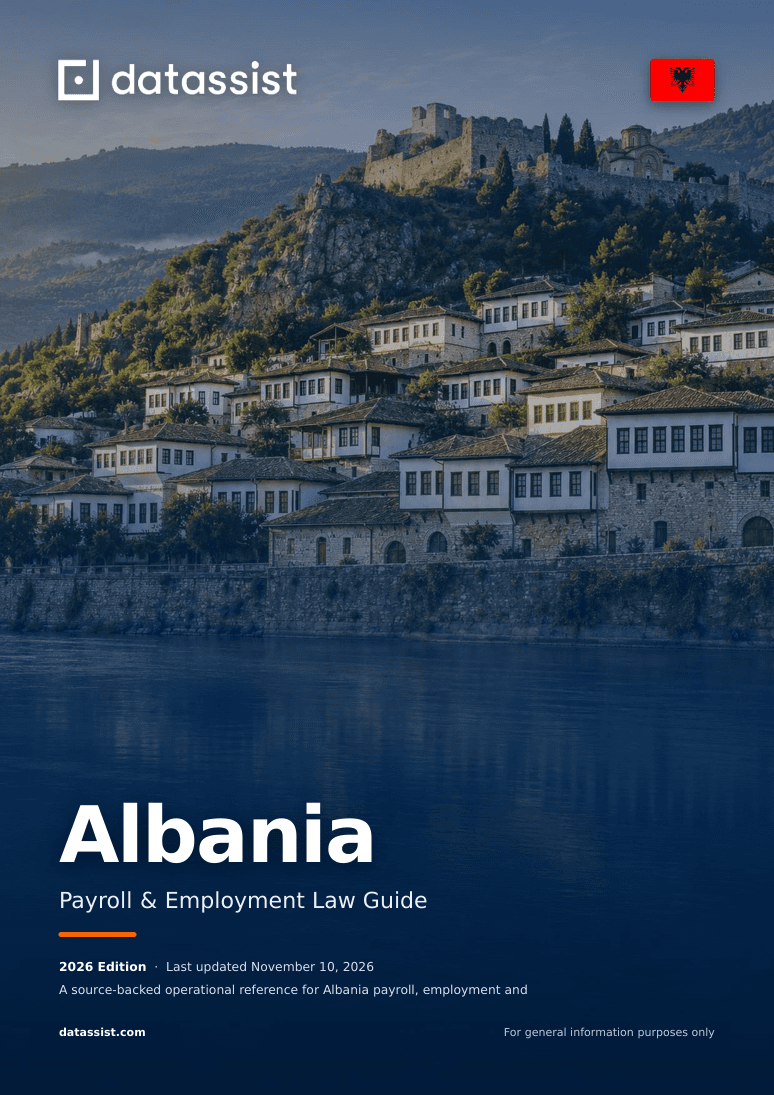
Albania Payroll & Employment Guide
This guide supports employers using a local entity or coordinating Albania payroll within a multi-country operation. It reflects sources checked on November 10, 2026. Sector, collective agreement, worker status and local practice can change the result, so conditional items must be confirmed before payroll.
- 8
- pages
- 9
- chapters
- 1.425
- words
- ALL
- currency
At a glance
At a Glance
- ALL 50,000
- 2026 monthly minimum wage
- 40h
- Standard working week
- 11.2%
- Employee social and health contributions
- 16.7%
- Employer social and health contributions
What's in the guide
9 chapters, 8 pages
The opening summary of each chapter is below. Full text, tables and rates are in the PDF.
Company Formation and Business Environment
Employer structure, registrations and the contract layer.
A limited liability company can be registered through the National Business Center and the e-Albania channel. The single application supports commercial, tax, social insurance, health insurance and labour registration. Employer access and employee reporting still need to be tested before first payroll.
Working Conditions and Leave Entitlements
Working time, leave and periodic payment rules.
The standard working week is 40 hours. Employees receive at least 22 working days of paid annual leave. Evening work attracts at least a 20% premium and night work at least 50%. Weekly-rest and public-holiday work require premium pay or compensatory treatment under the Labour Code.
Tax and Social Security
Income tax, contributions and social security parameters.
The 2026 monthly minimum wage is ALL 50,000. Employment income uses progressive tax bands and deductions, with 13% applying within the middle band and 23% above ALL 200,000. Employees contribute 9.5% social insurance and 1.7% health insurance. Employers contribute 15% social insurance and 1.7% health insurance. The 2026 maximum social contribution base is ALL 186,416, while employee health contributions use actual gross salary without that cap.
Payroll Operations
Payroll calendar, filings and record obligations.
Payroll tax, social insurance and health insurance are declared and paid electronically by the 20th day of the following month. A new employee is declared at least 24 hours before work begins, and a leaver is reported within 10 days. The accepted declarations, bank evidence and payslip should reconcile.
Hiring and Termination
Onboarding, contracts, notice and termination controls.
Employment contracts should be written and state the role, pay, place and working time. Probation is generally up to 3 months, with 5 days' notice during probation. After probation, notice generally increases with service from 1 to 3 months. Employer termination requires a lawful reason and a documented hearing and notice process where applicable.
Wages and Benefits
Pay floors, additional payments and benefits.
Base pay must not fall below ALL 50,000 a month for full-time work from January 1, 2026. Overtime, evening, night, weekly-rest and holiday hours should remain distinct in the payroll input. There is no general statutory 13th salary obligation, but contracts and collective arrangements may provide bonuses.
Visas and Work Permits
Local hiring, foreign workers and mobility rules.
A third-country national generally uses the unique permit route through e-Albania. Where labour-market approval is required, the National Agency for Employment and Skills target is 10 working days. The wider residence and unique-permit process may take 4 to 12 weeks, so work should not begin on the basis of an application receipt alone.
Practical Notes and Compliance Risks
Controls before first payroll and throughout the operation.
The main risks are late employee declarations, applying the social contribution ceiling to health contributions and flattening progressive income tax into one percentage. The monthly close should reconcile the employee register, time bands, contribution bases, tax return and bank payment.
Incentives and Employer Support Schemes
2026 employer support and conditional incentive schemes.
Employment and vocational programmes are administered through the National Agency for Employment and Skills. Support may cover training, internships or subsidised employment under a live call. It is not a universal payroll credit. Confirm the current call, participant eligibility, approval, retention period and payment evidence before recognition.
This guide is for general information only; it is not legal advice or a complete statement of the law. The content reflects the legislation in force when it was prepared, and legislation changes. Always take country-specific professional advice on a concrete case.
With Datassist
Let us review your Albania payroll structure together.
Albania payroll requires employment records, tax, contributions, immigration and payment evidence to operate on one calendar. Datassist helps international employers coordinate these controls and retain a reviewable payroll trail from one center.
Other countries
Other country guides
- TRY 70,893.00
- Gross minimum wage from 1 July 2026
- 40 hours
- Statutory working week
Employer Structure · Working Time & Leave · Tax & Social Security · Payroll Operations
View Guide
- 8%
- Minimum auto-enrolment pension contribution of qualifying earnings
- GBP 10,500
- Employment Allowance against employer Class 1 NIC
Employer Structure · Working Time & Leave · Tax & Social Security · Payroll Operations
View Guide
- 40h
- Normal working week in all three jurisdictions
- 20 days
- General annual-leave floor
Company Formation and Business Environment · Working Conditions and Leave Entitlements · Tax and Social Security · Payroll Operations · Hiring and Termination · Wages and Benefits · Visas and Work Permits · Practical Notes and Compliance Risks · Incentives and Employer Support Schemes
View Guide