
All country guides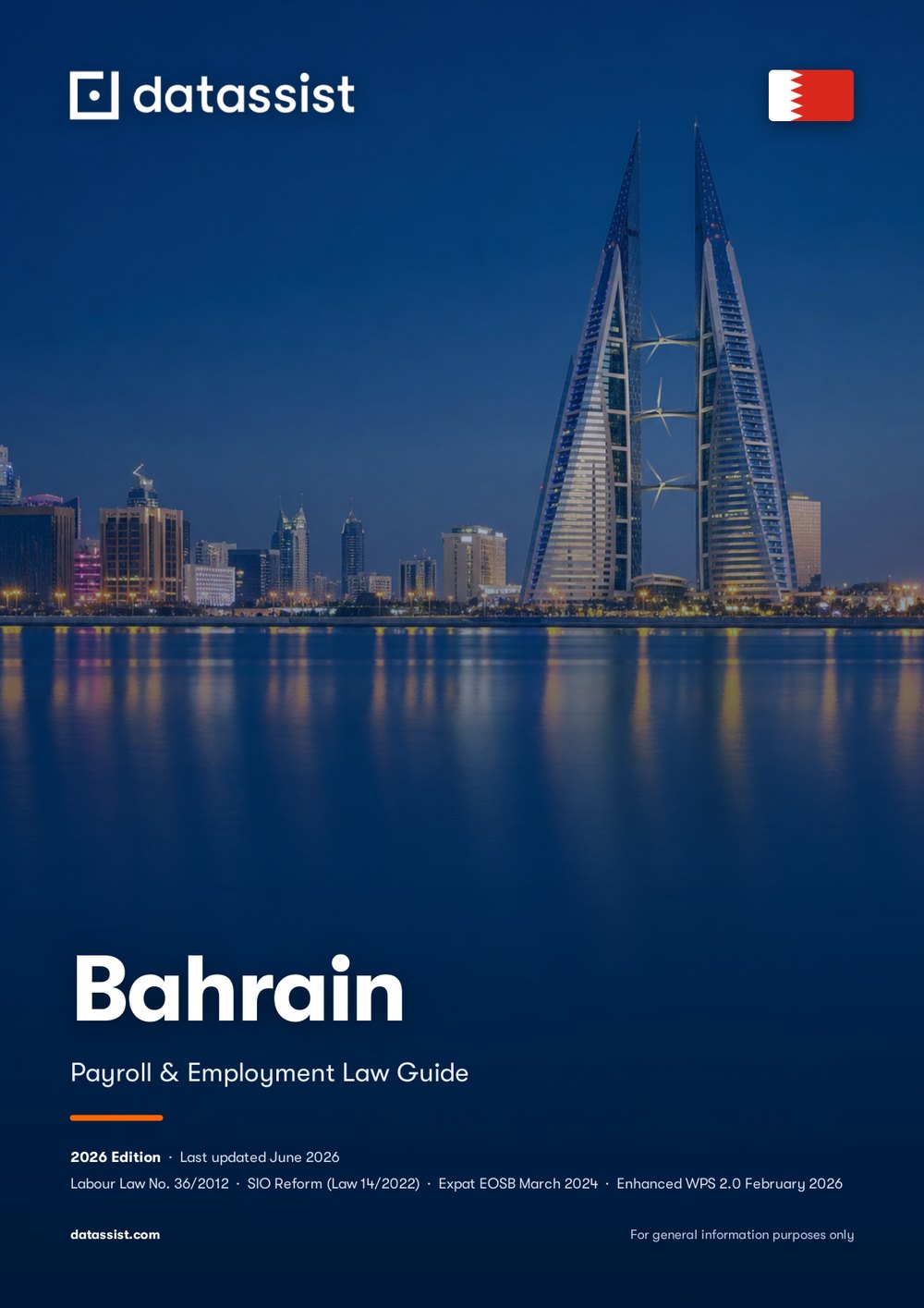
 Gulf (GCC)
 Gulf (GCC)
 Gulf (GCC)
Free guide · Gulf (GCC)
Bahrain Payroll & Employment Guide 2026
Bahrain combines a tax-free salary environment with one of the most open expatriate labour markets in the Gulf. There is no personal income tax, yet employers carry defined obligations for working hours, leave, Social Insurance Organisation (SIO) contributions, wage protection through WPS 2.0, end-of-service benefits and Bahrainisation. The Flexi-Permit lets expatriates work for multiple employers without a single sponsor, a feature unique to the Kingdom. Two structural changes shape 2026 payroll: the SIO-managed expatriate end-of-service system introduced in March 2024, and Enhanced WPS 2.0, mandatory from February 2026, which shifts wage protection from post-payment reporting to pre-validation. Each is covered in the sections that follow.
At a glance
Four key payroll indicators for Bahrain
0%PERSONAL INCOME TAX
18%SIO EMPLOYER RATE · NATIONALS 2026
30dANNUAL LEAVE · 1+ YEAR
15thSALARY DEADLINE · FOLLOWING MONTH
What is inside
8 chapters, 11 pages
The opening summary of every chapter is below. Download the PDF for the full text, tables and rates.
Company Setup
Entity types, Free Zones, the unique Flexi-Permit and the Employer of Record route.
Foreign employers can operate through a local entity, a Free Zone presence, or an Employer of Record. The WLL, Bahrain's limited liability company, is the most common structure and allows 100% foreign ownership in many sectors. Bahrain's distinctive Flexi-Permit lets expatriates work for multiple employers without a single sponsor, a mobility feature found nowhere else in the Gulf.
Working Hours & Leave
Annual, sick, maternity, Hajj and bereavement entitlements plus the post-delivery rest rule.
The Labour Law sets out annual, sick, maternity and a range of statutory leave. Annual holiday pay is paid before leave begins, and any unused balance is cashed out on termination. The most significant rule for payroll is the mandatory 40-day post-delivery rest, which cannot be waived.
Social Security — SIO
National contribution schedule to 2028 and the limited expatriate coverage.
There is no personal income tax in Bahrain. Social insurance runs through the Social Insurance Organisation (SIO), which provides full coverage for Bahraini nationals. Expatriates have limited SIO coverage plus the SIO-managed end-of-service indemnity introduced in March 2024. The employer rate for nationals rises by one percentage point every January through 2028.
Expat EOSB — March 2024 Reform
The SIO-managed indemnity, the two accounting periods and illustrative employer cost.
Resolution No. 109/2023 fundamentally changed the expatriate end-of-service system from March 2024. The employer no longer pays a lump sum on termination. Instead, monthly contributions go to SIO, and the employee claims the accumulated amount directly from SIO on departure. Two accounting periods must now be tracked separately.
WPS 2.0 — Wage Protection
Pre-validation, the Wage Responsible Person, Fawri transfers and the salary deadline.
Enhanced WPS 2.0 is mandatory for all private-sector employers from February 2026. It shifts wage protection from post-payment reporting to pre-validation: the salary file must be approved before transfers execute. Salaries must reach employees by the 15th of the following month, and a monthly file is required even when nothing changes.
Hiring & Termination
Probation, notice periods and dismissal for serious misconduct under the Labour Law.
Probation is capped at three months, during which either party may terminate on one day's notice. For unlimited-term contracts the statutory notice is 30 days under Article 99, although contracts often extend this to between 30 and 90 days. Dismissal for serious misconduct under Article 107 requires no notice.
Bahrainisation
Quota levy, Tamkeen subsidies and the 2026 national- employment target.
Bahrainisation sets localisation quotas backed by a per-permit levy and offset by Tamkeen support for hiring and retaining Bahraini nationals. The 2026 government target is 50,000 employment opportunities per year for Bahrainis, and employers should model both the levy above quota and the available subsidies.
Practical Notes
The checks that prevent the most common and most costly Bahrain payroll errors.
The obligations in this guide reduce to a short list of checks that prevent the most common and most costly Bahrain payroll errors. Each should be settled before the first pay run.
This guide is general information, not legal advice or a complete statement of the law. It reflects the legislation in force when it was prepared, and legislation changes. Always seek country-specific professional advice for a specific situation.
With Datassist
Running payroll and employment operations in Bahrain
Employing people in Bahrain means applying the rules in this guide again every pay cycle: tracking rates, filing social security, running compliant wage payment channels and calculating end-of-service entitlements. Datassist teams exist so you can manage that from a single point.
Other countries
Other country guides
Gulf (GCC)Kuwait
0% PERSONAL INCOME TAX30d ANNUAL LEAVE ENTITLEMENT
Covers:
View the guide Company setupWorking hours & leaveTax & social securityEnd-of-service (EOSB)+2
Gulf (GCC)Oman
0% PERSONAL INCOME TAX48h MAXIMUM WORKING WEEK
Covers:
View the guide Company setupWorking hours & leaveTax & social securityMinimum wage & benefits+4
Gulf (GCC)Qatar
0% PERSONAL INCOME TAX48h MAXIMUM WORKING WEEK
Covers:
View the guide Company setupWorking hours & leaveTax & social securityMinimum wage & benefits+3
Need to run payroll and employment operations in Bahrain?
Talk to a Datassist specialist and plan your local compliance, social security and wage payment processes together.