
All country guides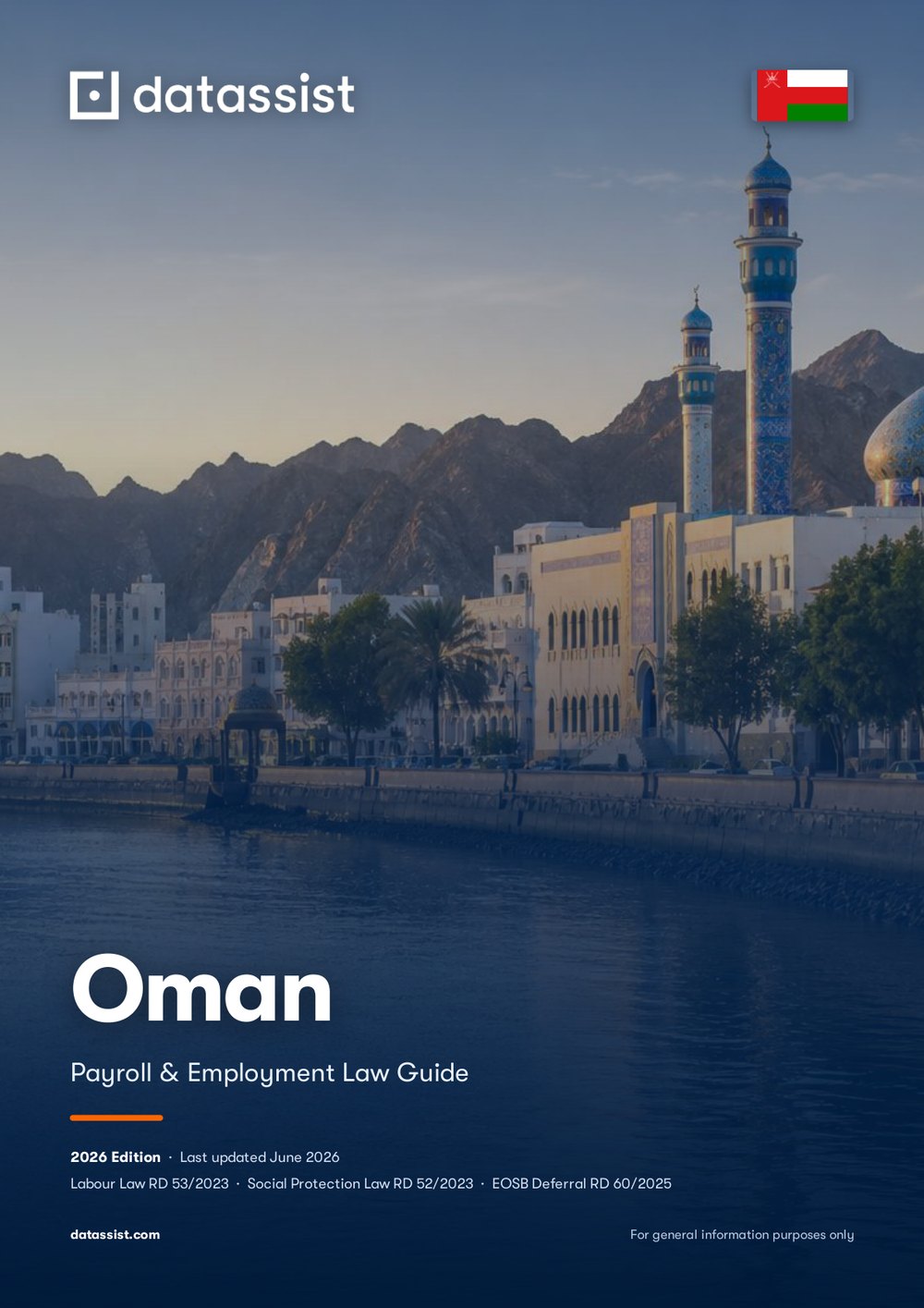
 Gulf (GCC)
 Gulf (GCC)
 Gulf (GCC)
Free guide · Gulf (GCC)
Oman Payroll & Employment Guide 2026
Oman pairs a tax-free salary environment with the most comprehensive labour-law reform in the Gulf. There is no personal income tax, yet employers carry defined obligations for working hours, expanded leave, Social Protection Fund contributions, wage protection through WPS, end-of-service gratuity and Omanisation. Oman is also the only Gulf state that explicitly grants workers the right to form trade unions and bargain collectively. Two reforms shape 2026 payroll: the sweeping Labour Law RD 53/2023, which overhauled hours, overtime, sick, maternity, paternity and caregiver leave, and the Social Protection Law RD 52/2023, whose new SPF contribution schedule is phasing in. A third decree, RD 60/2025, deferred the expatriate savings scheme that was set to replace end-of-service gratuity. Each is covered in the sections that follow.
At a glance
Four key payroll indicators for Oman
0%PERSONAL INCOME TAX
48hMAXIMUM WORKING WEEK
14.5%SPF EMPLOYER RATE · 2026
182dMAXIMUM SICK LEAVE
What is inside
8 chapters, 11 pages
The opening summary of every chapter is below. Download the PDF for the full text, tables and rates.
Company Setup & Key Platforms
LLC ownership, the day-one Omanisation obligation, the EOR route, WPS and SPF.
Foreign employers can operate through a local entity or an Employer of Record. The limited liability company is the most common vehicle, and many sectors now allow full foreign ownership. Whichever route is chosen, a day-one Omanisation obligation and two compliance systems, the Social Protection Fund and the Wage Protection System, govern day-to-day payroll.
Working Hours & Annual Leave
The 48-hour week, Ramadan and remote work, the new overtime tiers, and annual-leave carry-over.
RD 53/2023 caps the working week at 48 hours and eight hours per day, down from nine hours under the old law, reduces hours during Ramadan and expressly permits remote work. It also replaced the old flat overtime premium with tiered rates, and introduced a 30-day annual-leave carry-over right.
Sick, Maternity & Family Leave
The 182-day sick schedule plus expanded maternity, new paternity and caregiver rights.
RD 53/2023 expanded sick leave from a maximum of 10 weeks to 182 calendar days on a declining pay scale, raised maternity leave to 98 days with unlimited occurrences, and introduced new paternity and caregiver entitlements for both Omani nationals and expatriates.
Social Security — SPF
The phased Omani-national rates and the deferred expatriate coverage timeline.
There is no personal income tax in Oman. Social insurance runs through the Social Protection Fund (SPF, formerly PASI), which covers Omani nationals across five phased branches. Expatriate coverage is being introduced separately on a deferred timeline, with retirement provision still met through end-of-service gratuity until 2027.
End-of-Service Gratuity — EOSB
The 31 July 2023 formula split, the base and cap, and a worked calculation.
RD 53/2023 changed the gratuity formula for expatriate employees, and the Ministry confirmed in October 2024 that service before and after 31 July 2023 is calculated on two different formulas. Gratuity is based on the last drawn basic wage only, capped at 24 months' basic salary, with a one-year minimum service requirement.
Minimum Wage & WPS
The Omani wage floor, the annual increment and mandatory wage-protection filing.
Oman sets a statutory minimum wage for Omani nationals in the private sector only. Expatriate pay is contract-determined. From January 2026 a mandatory annual increment applies to Omanis, and all private-sector wages must flow through the Wage Protection System.
Hiring, Termination & Omanisation
Contract limits, the new redundancy route and Omanisation quotas and penalties.
RD 53/2023 capped the total length of fixed-term contracts, formally recognised redundancy as a permitted termination ground subject to committee approval, and tightened Omanisation obligations. Foreign-owned companies must hire Omani nationals from day one and larger employers file an annual localisation plan.
Practical Notes
The checks that prevent the most common and most costly Oman payroll errors.
The obligations in this guide reduce to a short list of checks that prevent the most common and most costly Oman payroll errors. Each should be settled before the first pay run and revisited as the RD 53/2023 and RD 60/2025 reforms continue to phase in.
This guide is general information, not legal advice or a complete statement of the law. It reflects the legislation in force when it was prepared, and legislation changes. Always seek country-specific professional advice for a specific situation.
With Datassist
Running payroll and employment operations in Oman
Employing people in Oman means applying the rules in this guide again every pay cycle: tracking rates, filing social security, running compliant wage payment channels and calculating end-of-service entitlements. Datassist teams exist so you can manage that from a single point.
Other countries
Other country guides
Gulf (GCC)Bahrain
0% PERSONAL INCOME TAX18% SIO EMPLOYER RATE · NATIONALS 2026
Covers:
View the guide Company setupWorking hours & leaveTax & social securityEnd-of-service (EOSB)+3
Gulf (GCC)Kuwait
0% PERSONAL INCOME TAX30d ANNUAL LEAVE ENTITLEMENT
Covers:
View the guide Company setupWorking hours & leaveTax & social securityEnd-of-service (EOSB)+2
Gulf (GCC)Qatar
0% PERSONAL INCOME TAX48h MAXIMUM WORKING WEEK
Covers:
View the guide Company setupWorking hours & leaveTax & social securityMinimum wage & benefits+3
Need to run payroll and employment operations in Oman?
Talk to a Datassist specialist and plan your local compliance, social security and wage payment processes together.