
All country guides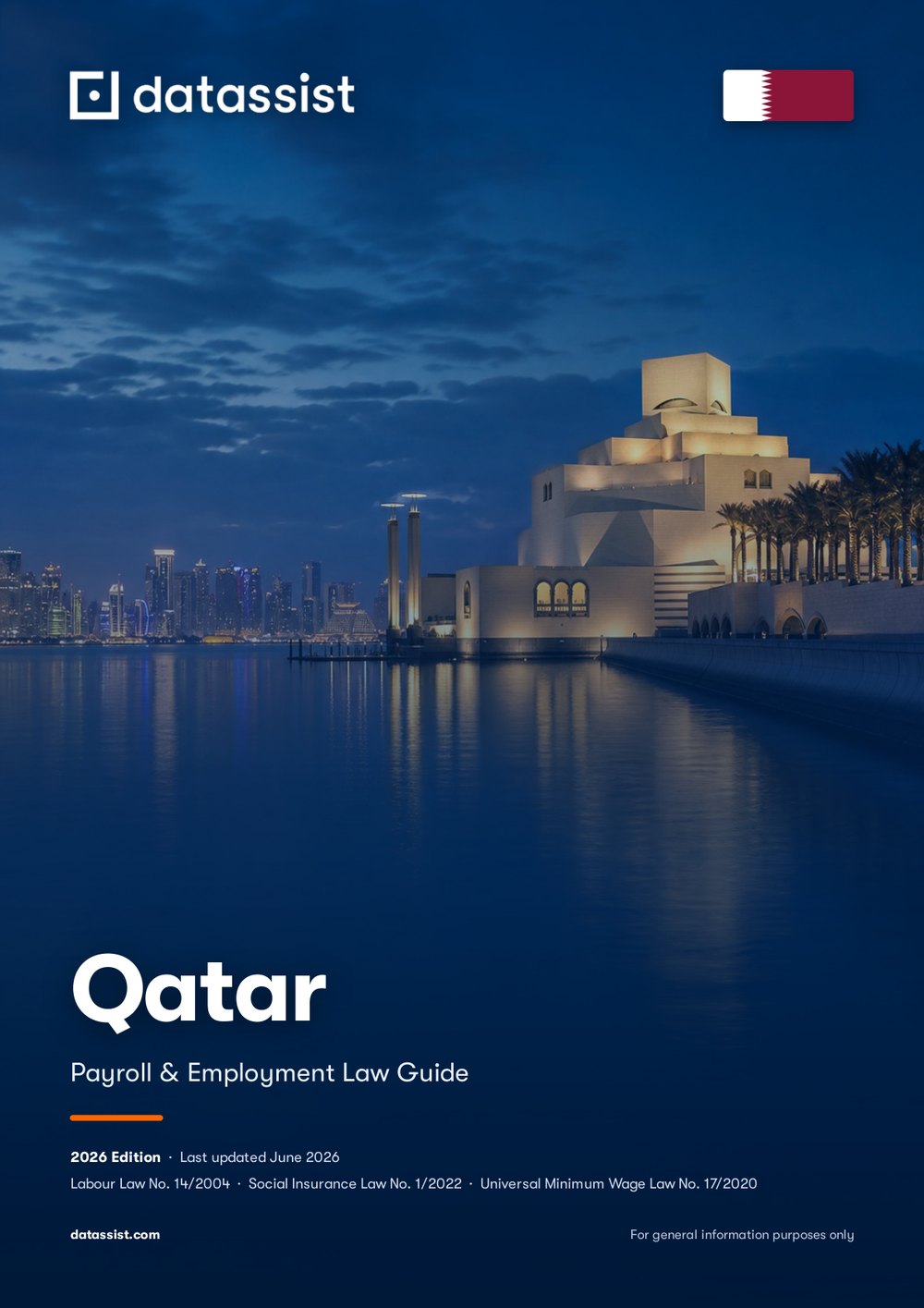
 Gulf (GCC)
 Gulf (GCC)
 Gulf (GCC)
Free guide · Gulf (GCC)
Qatar Payroll & Employment Guide 2026
Qatar combines a tax-free salary environment with two reforms that set it apart in the Gulf: it was the first Gulf state to introduce a universal, non-discriminatory minimum wage, and it has effectively abolished the kafala system by removing both the No Objection Certificate and the exit permit. Employers still carry clear obligations for working hours, leave, GRSIA social insurance, wage protection and end-of-service gratuity. Payroll in Qatar is monitored electronically through the Wage Protection System, with AI-assisted deviation detection arriving in 2026. The heat-stress ban on midday outdoor work and the phased Qatarisation quotas are the two operational rules most often overlooked, and both are covered below.
At a glance
Four key payroll indicators for Qatar
0%PERSONAL INCOME TAX
48hMAXIMUM WORKING WEEK
1,800 QARMINIMUM TOTAL PACKAGE
14%GRSIA EMPLOYER RATE
What is inside
6 chapters, 9 pages
The opening summary of every chapter is below. Download the PDF for the full text, tables and rates.
Company Setup
Entity structures, the separate QFC jurisdiction, and the Employer of Record route.
Foreign employers can operate through a local entity or an Employer of Record. The limited-liability WLL is the most common structure, with 100% foreign ownership now permitted in many sectors. The Qatar Financial Centre is a separate jurisdiction with its own employment law and tax regime, so the framework should be confirmed before an offer is made.
Working Hours & Leave
Hours, the summer heat-stress ban, and annual, sick, maternity and Hajj leave.
The Labour Law caps the working week at 48 hours and eight hours per day, reduces hours during Ramadan, and enforces a strict summer heat-stress ban on outdoor work. Annual leave begins after one year of continuous service, and unused leave is paid out on termination.
Social Security & Minimum Wage
GRSIA for Qatari nationals and the universal minimum-wage package floor.
There is no personal income tax in Qatar. GRSIA social insurance covers Qatari nationals only, under Law No. 1/2022 effective January 2023. Every worker, regardless of nationality, is protected by the universal minimum wage, a package floor that contracts cannot fall below.
End-of-Service & WPS
EOSB entitlement, payment deadlines and WPS payroll operations.
End-of-service gratuity is calculated on the last basic wage only, after a minimum of one year's service. Salaries are paid and monitored through the Wage Protection System overseen by MADLSA and the Qatar Central Bank, with automatic detection of payment deviations.
Hiring, Termination & Mobility
Probation, notice, and the reforms that ended the kafala system.
Probation runs to a maximum of six months. Notice depends on tenure, and Qatar's labour-mobility reforms have removed the historic barriers to changing employer, making the market considerably more flexible than its Gulf neighbours.
Practical Notes
The checks that prevent the most common and most costly Qatar payroll errors.
The obligations in this guide reduce to a short list of checks that prevent the most common and most costly Qatar payroll errors. Each should be settled before the first pay run.
This guide is general information, not legal advice or a complete statement of the law. It reflects the legislation in force when it was prepared, and legislation changes. Always seek country-specific professional advice for a specific situation.
With Datassist
Running payroll and employment operations in Qatar
Employing people in Qatar means applying the rules in this guide again every pay cycle: tracking rates, filing social security, running compliant wage payment channels and calculating end-of-service entitlements. Datassist teams exist so you can manage that from a single point.
Other countries
Other country guides
Gulf (GCC)Bahrain
0% PERSONAL INCOME TAX18% SIO EMPLOYER RATE · NATIONALS 2026
Covers:
View the guide Company setupWorking hours & leaveTax & social securityEnd-of-service (EOSB)+3
Gulf (GCC)Kuwait
0% PERSONAL INCOME TAX30d ANNUAL LEAVE ENTITLEMENT
Covers:
View the guide Company setupWorking hours & leaveTax & social securityEnd-of-service (EOSB)+2
Gulf (GCC)Oman
0% PERSONAL INCOME TAX48h MAXIMUM WORKING WEEK
Covers:
View the guide Company setupWorking hours & leaveTax & social securityMinimum wage & benefits+4
Need to run payroll and employment operations in Qatar?
Talk to a Datassist specialist and plan your local compliance, social security and wage payment processes together.