
All country guides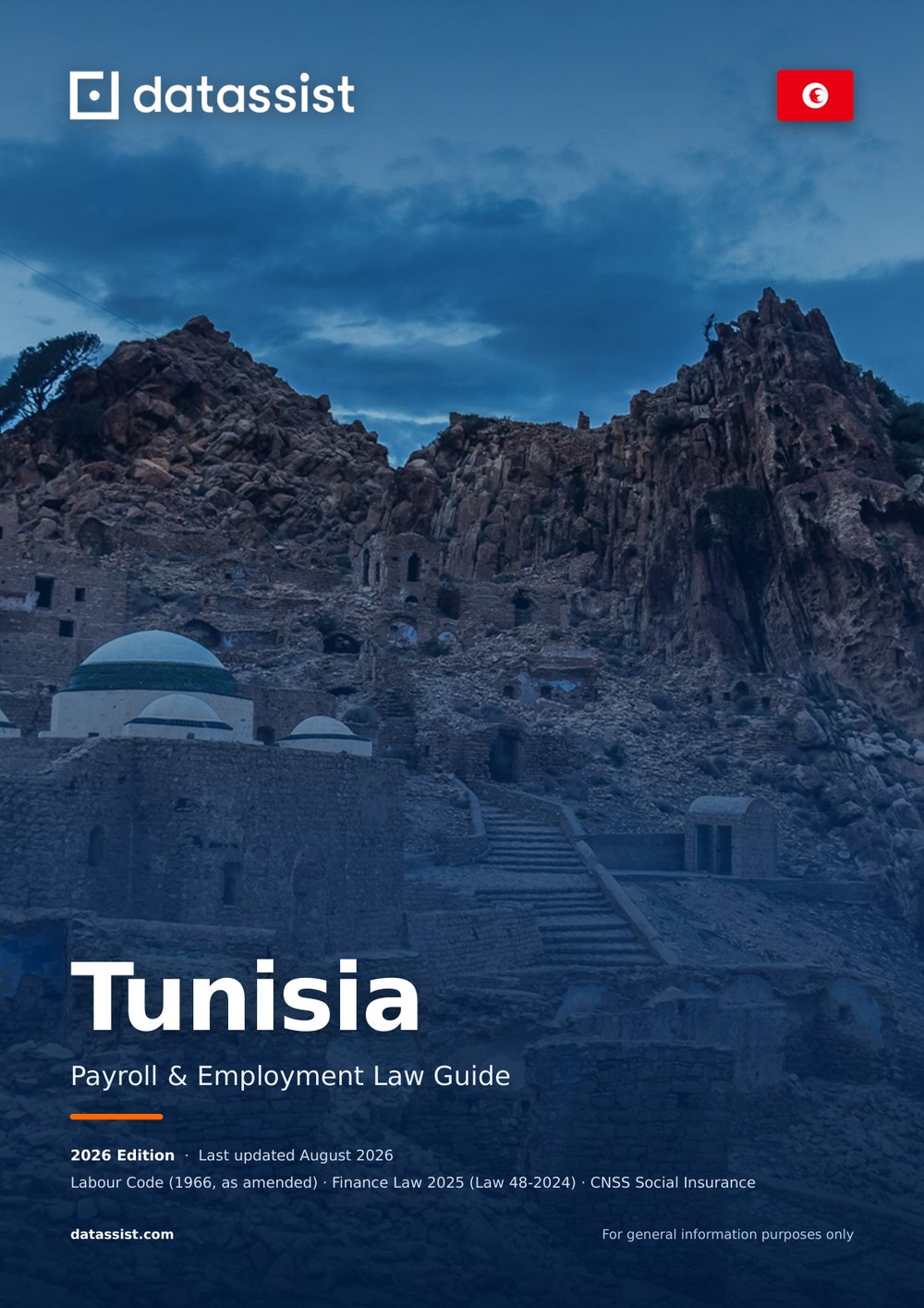
 North Africa
 North Africa
 North Africa
Free guide · North Africa
Tunisia Payroll & Employment Guide 2026
Regional Note: Tunisia is a nearshore tech and BPO hub for European companies, especially French-speaking markets. French is the operative language for all payroll, contracts, and regulatory filings. Unlike Gulf countries, there is NO expatriate exemption from CNSS or IRPP: all employees (Tunisian and foreign) contribute at identical rates. Skilled tech talent costs 60–70% less than equivalent French/Belgian profiles.
At a glance
Four key payroll indicators for Tunisia
48hMAXIMUM WORKING WEEK
17.07%EMPLOYER CNSS RATE
TND 528.32048-HOUR MONTHLY SMIG
40%TOP IRPP RATE
What is inside
10 chapters, 13 pages
The opening summary of every chapter is below. Download the PDF for the full text, tables and rates.
Company Setup & Business Environment
Tunisia is a nearshore tech and BPO hub for European companies, especially French-speaking markets.
Working Hours & Leave
Maximum: 48 hours/week (most sectors); 40 hours/week (administrative roles).
CNSS Social Insurance: 2026
2025/2026 Change: Finance Law 2025 (Law 48-2024) increased both employer and employee CNSS rates by +0.5% effective 1 January 2025, to fund the new
Income Tax: IRPP
Unemployment Insurance Fund for… Gross salary − CNSS employee contributions (9.68%)
Minimum Wage (SMIG)
Note: SMIG last updated January 2025; unchanged for 2026.
Gross-to-Net Illustration (TND 3,000/month)
Note: Employer on-cost ~17–18% above gross for standard roles.
Severance Pay
Statutory severance under the Labour Code.
Hiring & Termination
Written contracts in Arabic or French.
Work Permits & Visas for Foreign Employees
Foreign employees must have both an employment contract and a residence card with work authorisation before starting work in Tunisia.
Practical Notes & Key Risks
CNSS rate changed January 2025: Both employer (17.07%) and employee (9.68%) rates increased by +0.5%.
This guide is general information, not legal advice or a complete statement of the law. It reflects the legislation in force when it was prepared, and legislation changes. Always seek country-specific professional advice for a specific situation.
With Datassist
Running payroll and employment operations in Tunisia
Employing people in Tunisia means applying the rules in this guide again every pay cycle: tracking rates, filing social security, running compliant wage payment channels and calculating end-of-service entitlements. Datassist teams exist so you can manage that from a single point.
Other countries
Other country guides
North AfricaAlgeria
40h MAXIMUM WORKING WEEKDZD 24,000 2026 MONTHLY MINIMUM WAGE
Covers:
View the guide Company setupWorking hours & leaveMinimum wage & benefitsHiring & termination+1
North AfricaEgypt
27.5% TOP INCOME-TAX BAND48h MAXIMUM WORKING WEEK
Covers:
View the guide Company setupWorking hours & leaveTax & social securityMinimum wage & benefits+2
North AfricaLibya
48h MAXIMUM WORKING WEEKLYD 1,000 MONTHLY MINIMUM WAGE
Covers:
View the guide Working hours & leaveTax & social securityMinimum wage & benefitsWork permits & visas
Need to run payroll and employment operations in Tunisia?
Talk to a Datassist specialist and plan your local compliance, social security and wage payment processes together.